

Your project, your idea
This is the finale: you invent your own drone mission, code it in AT-66BL, and present it to the class. Everything you learned this week - flight, blocks, loops, variables, decisions, custom blocks - comes together here. There’s no single right answer. The best projects are the ones you are excited about.
Everything you learned, combined into one project of your own
The rules
It must be your design
You choose the mission. Copying a demo exactly doesn’t count - remix it, extend it, make it yours.
It must be a program
The drone flies from your code (green flag), not by hand on the joysticks.
It must fly safely
Take off and land cleanly, in a clear space, with the stop button in reach.
You must present it
Demo it and explain how it works - including at least one problem you solved.
Pick your challenge level
Choose a tier that stretches you - judges reward ambition and polish. Or invent something not on this list.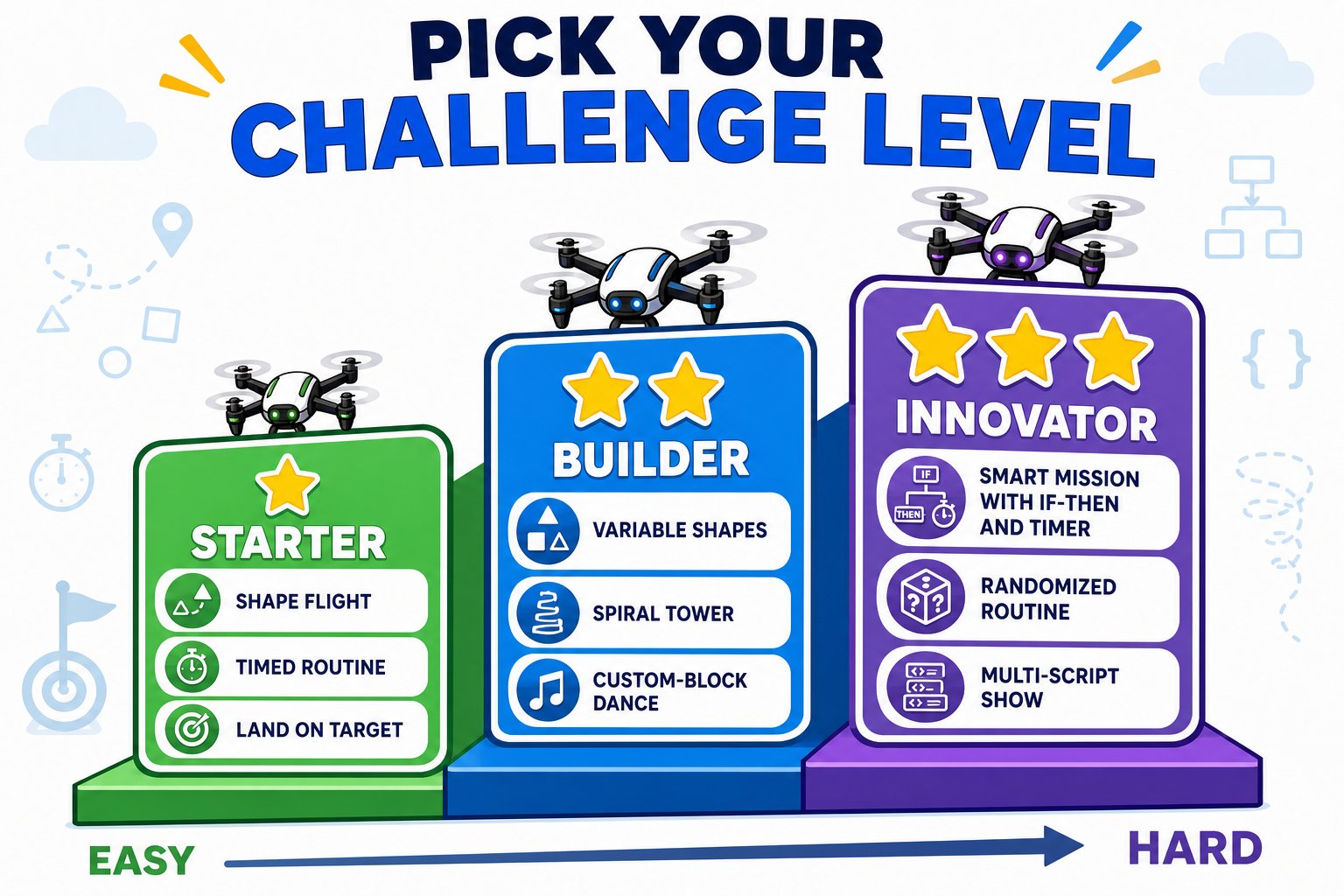
Three tiers - pick the one that stretches you without breaking you
- ⭐ Starter
- ⭐⭐ Builder
- ⭐⭐⭐ Innovator
- Shape flight - fly a clean square, triangle, or hexagon using a loop.
- Choreographed routine - a timed sequence of moves that feels like a little dance.
- Takeoff-to-target - fly a set path and land on a marked spot.
Your timeline
Roughly a half-day. Adjust to your class.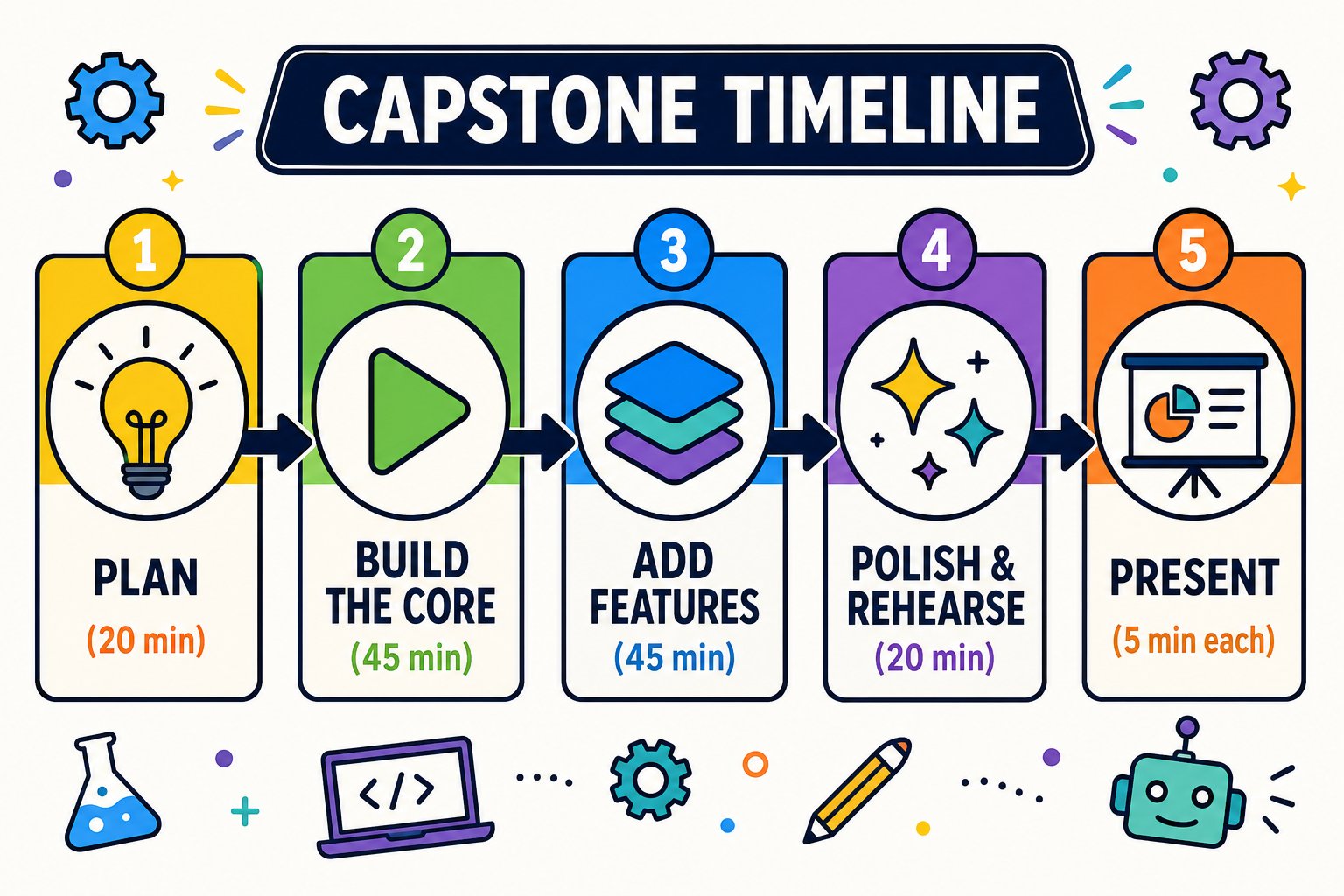
From idea to demo - how the capstone half-day flows
Plan (20 min)
Fill in the planning worksheet below. Decide what the drone does and what “done” looks like.
Build the core (45 min)
Get the simplest version flying first - take off, one move, land. Save it.
Add features (45 min)
Add one idea at a time - a loop, a variable, a decision. Test after each change.
Polish and rehearse (20 min)
Clean up your blocks, name your save, and practice your demo once.
Present (5 min each)
Show the class your mission and how you built it.
Planning worksheet
Copy these prompts and fill them in before you code:Mission
In one sentence, what will your drone do?
Blocks I'll use
List the key blocks (loop? variable? if-then? custom block?).
Success looks like
How will you know it worked?
Backup plan
If a part is too hard, what’s the simpler version you’ll show?
Present your project
Each student gets the floor. Cover these four things:What it does
Describe your mission and demo it (live or recorded).
How you built it
Walk through your blocks and the key ideas behind them.
What was hard
Share a bug you hit and how you fixed it - judges love this.
What's next
If you had another week, what would you add?
Judging criteria
Projects are scored out of 100 points across five categories. Use this rubric to aim high - and to judge fairly.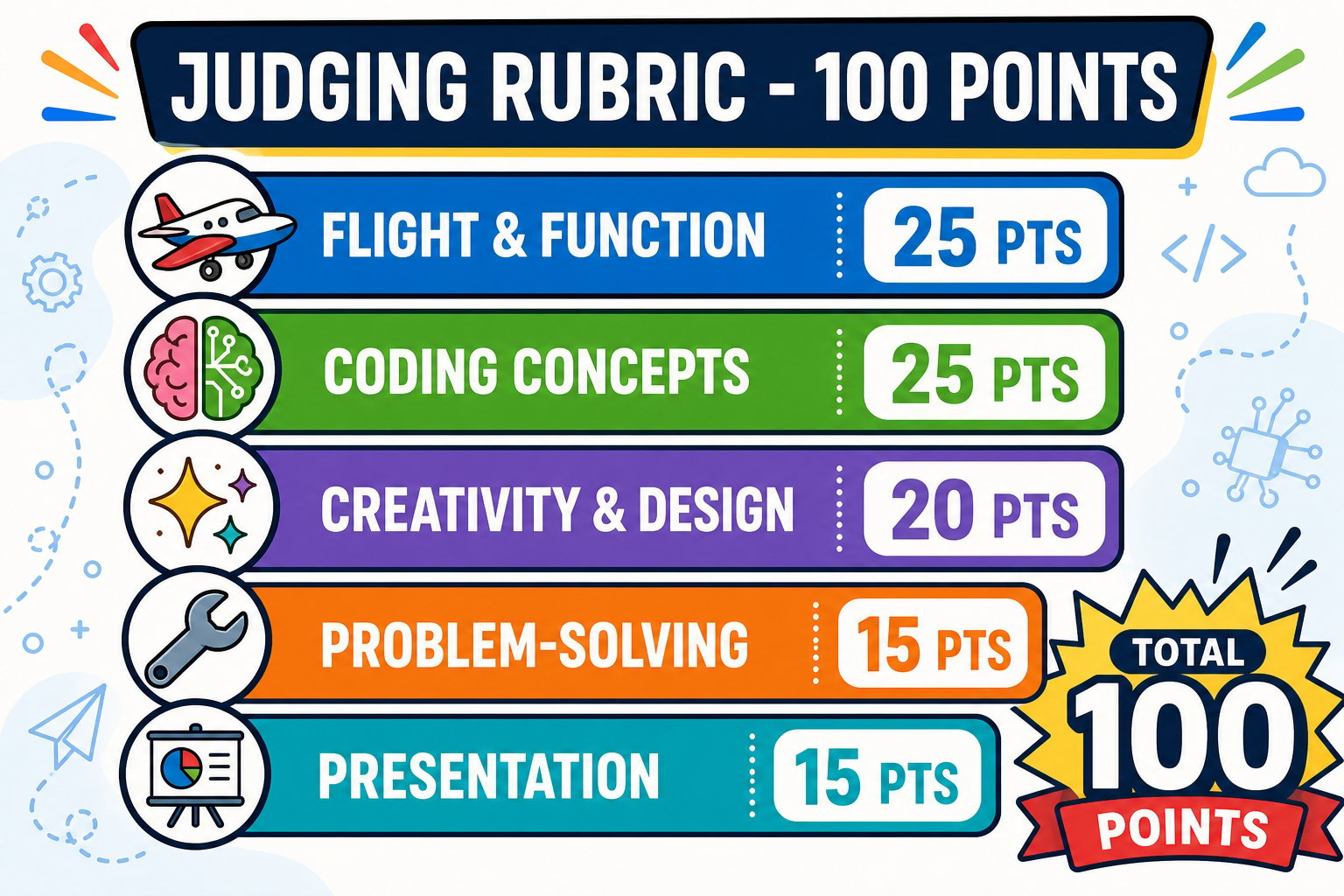
The 100-point rubric at a glance - print one per judge
Scoring guide
Flight & function (25)
Flight & function (25)
25 - flies the full mission reliably and lands cleanly. 15 - mostly works with minor hiccups. 5 - takes off and lands but the mission is incomplete.
Coding concepts (25)
Coding concepts (25)
25 - uses two or more of loop / variable / decision / custom block correctly and purposefully. 15 - uses one concept well. 5 - a straight list of moves with no loop or logic.
Creativity & design (20)
Creativity & design (20)
20 - a fresh, ambitious idea with a clear theme. 12 - a solid twist on a demo. 5 - a direct copy of a class example.
Problem-solving (15)
Problem-solving (15)
15 - explains a real bug and the fix in detail. 8 - mentions a challenge briefly. 0 - “it just worked.”
Presentation (15)
Presentation (15)
15 - clear, confident, and explains the code. 8 - demos but light on explanation. 3 - hard to follow.
Awards
Hand out a few fun categories so everyone can shine:Best Overall
Highest total score.
Most Creative
Most original mission idea.
Best Code
Cleverest use of loops, variables, or custom blocks.
Best Comeback
Best story of fixing a tough bug.
Smoothest Flight
Cleanest, most reliable flying.
Crowd Favorite
Voted by the class.
You designed, coded, and demonstrated an original drone mission that uses at least one core coding concept, and you explained how it works and what you learned.
Next: drone careers
See where these skills can take you.