

Fly live from your laptop
Before you write full programs, echo.pitsco.com has a fun built-in feature: keyboard control. Once your drone is connected, you can fly it live using the keys on your laptop - no controller and no code needed. It’s a great way to get comfortable flying from the computer.Open keyboard control
Connect first
Make sure your drone is connected (the toolbar shows DISCONNECT).
Click the controller icon
Click the blue game controller icon in the top-right of the workspace to open the Control Echo With Your Keyboard panel.
Enable keyboard control
Check the Enable keyboard control box. Now your key presses fly the drone.
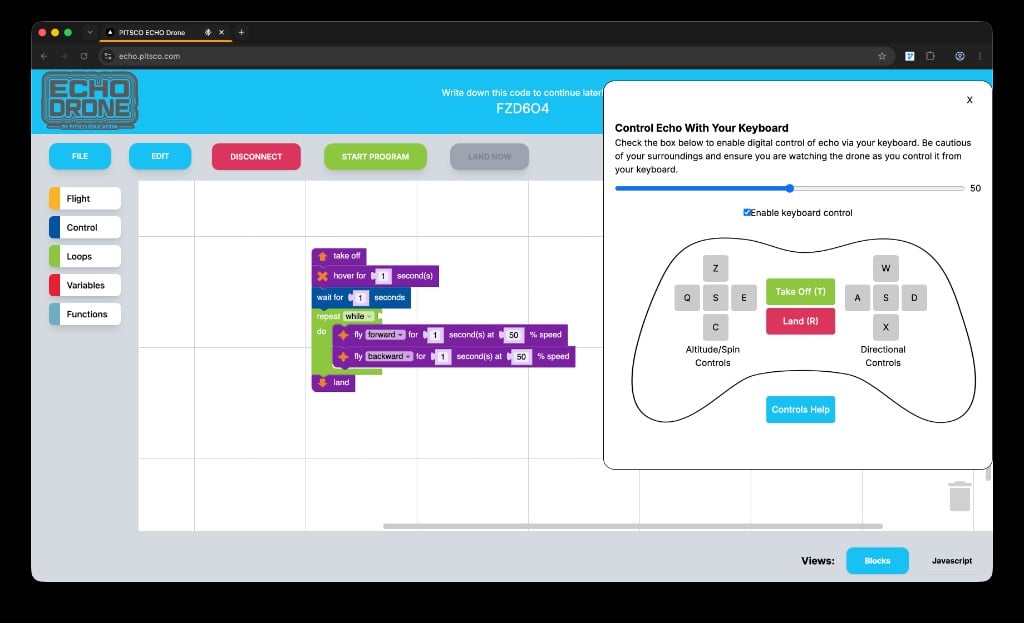
The built-in keyboard control panel
The key map
The panel shows two groups of keys, like the two sticks on a controller:Left hand: Altitude & Spin
Controls going up/down and spinning (yaw) left/right - the Z, Q, E, and C keys.
Right hand: Direction
Controls flying forward, back, left, and right - the W, A, S, D keys.
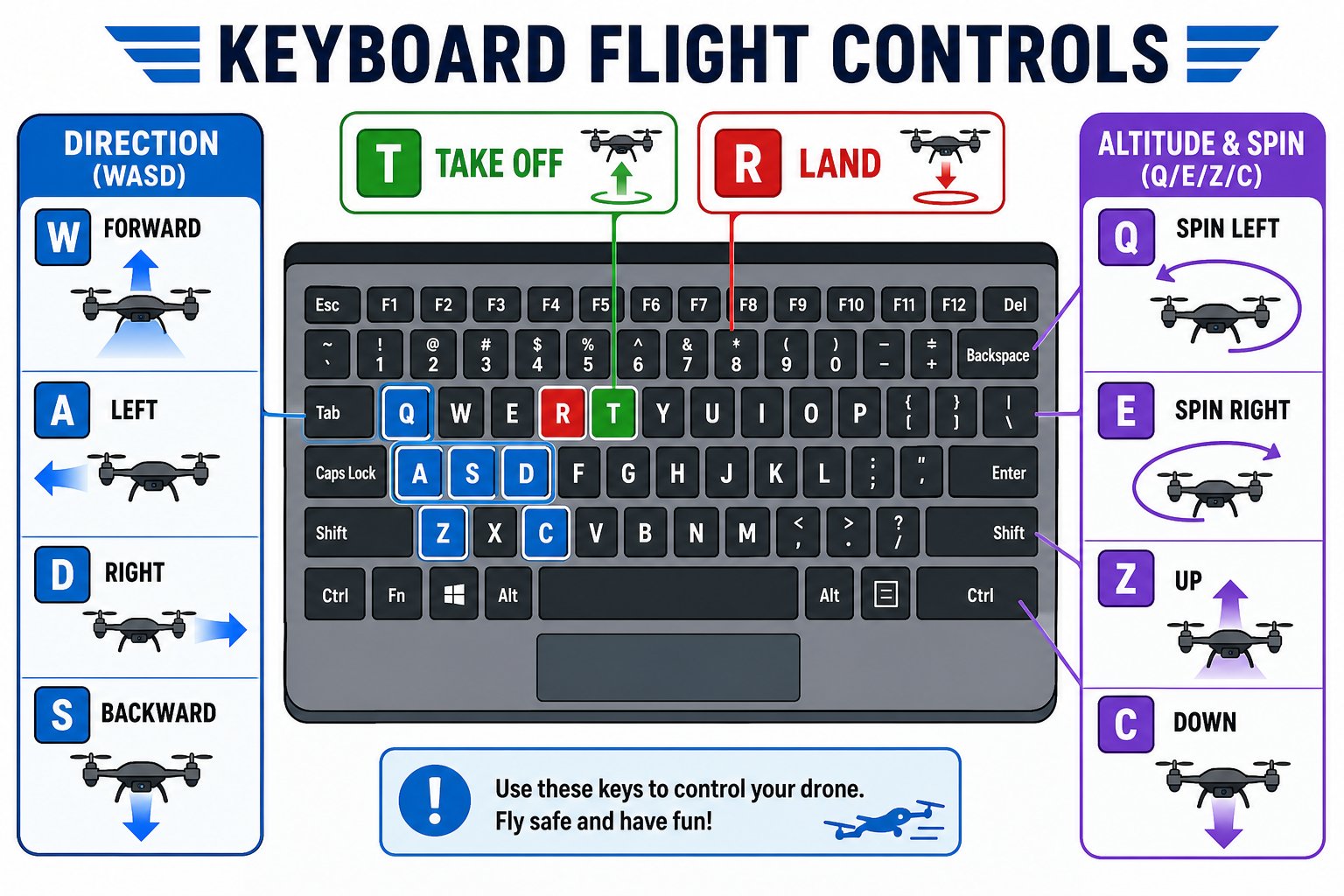
The two key clusters, mapped onto a laptop keyboard like a game controller
The exact key layout is shown right on the panel, and the Controls Help button explains each one. Glance at the on-screen pad if you forget a key.
Adjust the speed
The slider at the top of the panel sets how fast the drone responds (it starts around 50). Start low while you’re learning - a slower drone is much easier to control - and turn it up as you get comfortable.Practice
Take off and hover
Press T, let it hover, then press R to land. Repeat until it feels natural.
Gentle moves
Tap W, A, and D briefly to nudge the drone around. Small taps beat holding keys down.
Up and around
Practice Z/C to change height and Q/E to spin and face new directions.
Land on a target
Put a target on the floor and practice flying to it and landing with R.
You enabled keyboard control, took off with T, flew the drone around with the keys, and landed with R.