

What is a drone?
A drone is any aircraft that flies without a human pilot on board. The formal name is UAV - Unmanned Aerial Vehicle. Instead of a cockpit, a drone is flown by a person on the ground with a remote control, or by a computer running code (that’s where you come in this week). Your Echo Drone is a quadcopter: a drone lifted by four spinning propellers. It’s the most common design in the world because it’s simple, stable, and easy to control.The word “drone” originally described the low humming sound of male bees. Early remote-controlled aircraft made a similar buzzing noise - and the name stuck.
What every drone needs
No matter the size, every drone shares the same core ingredients. Together, these four systems make lift, provide power, think, and stay connected.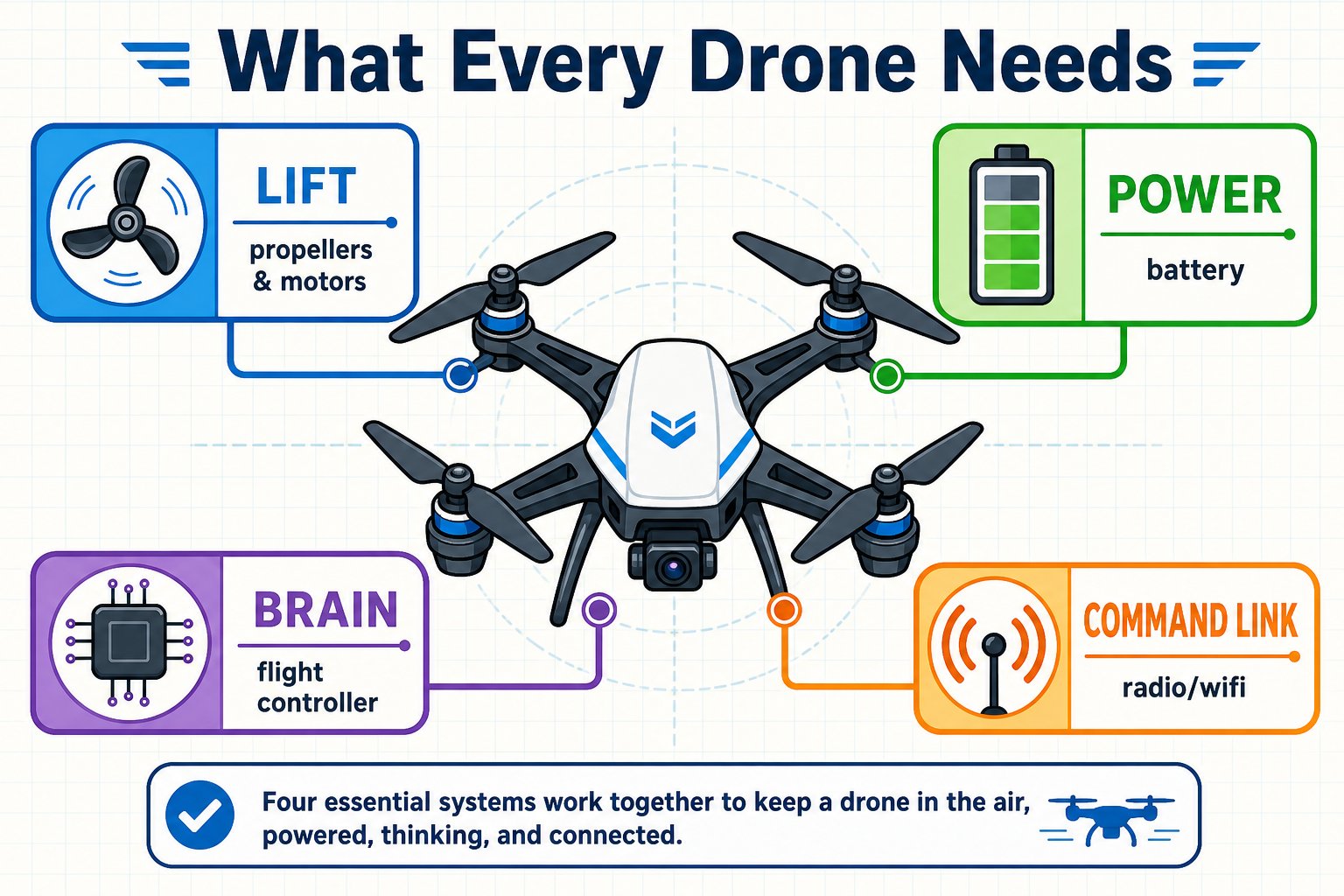
Every drone - toy or military - needs these four systems
A way to make lift
Propellers, rotors, or wings that push against the air to rise and stay up.
A power source
Usually a rechargeable lithium battery that drives the motors.
A flight controller
The small onboard “brain” that keeps the drone balanced and carries out commands.
A command link
A radio or Wi-Fi connection to a controller, phone, or computer.
Drones vs. other aircraft
A quadcopter isn’t the only way to fly - but it’s the friendliest to learn on. Here’s how the three main designs compare, and how each one makes lift.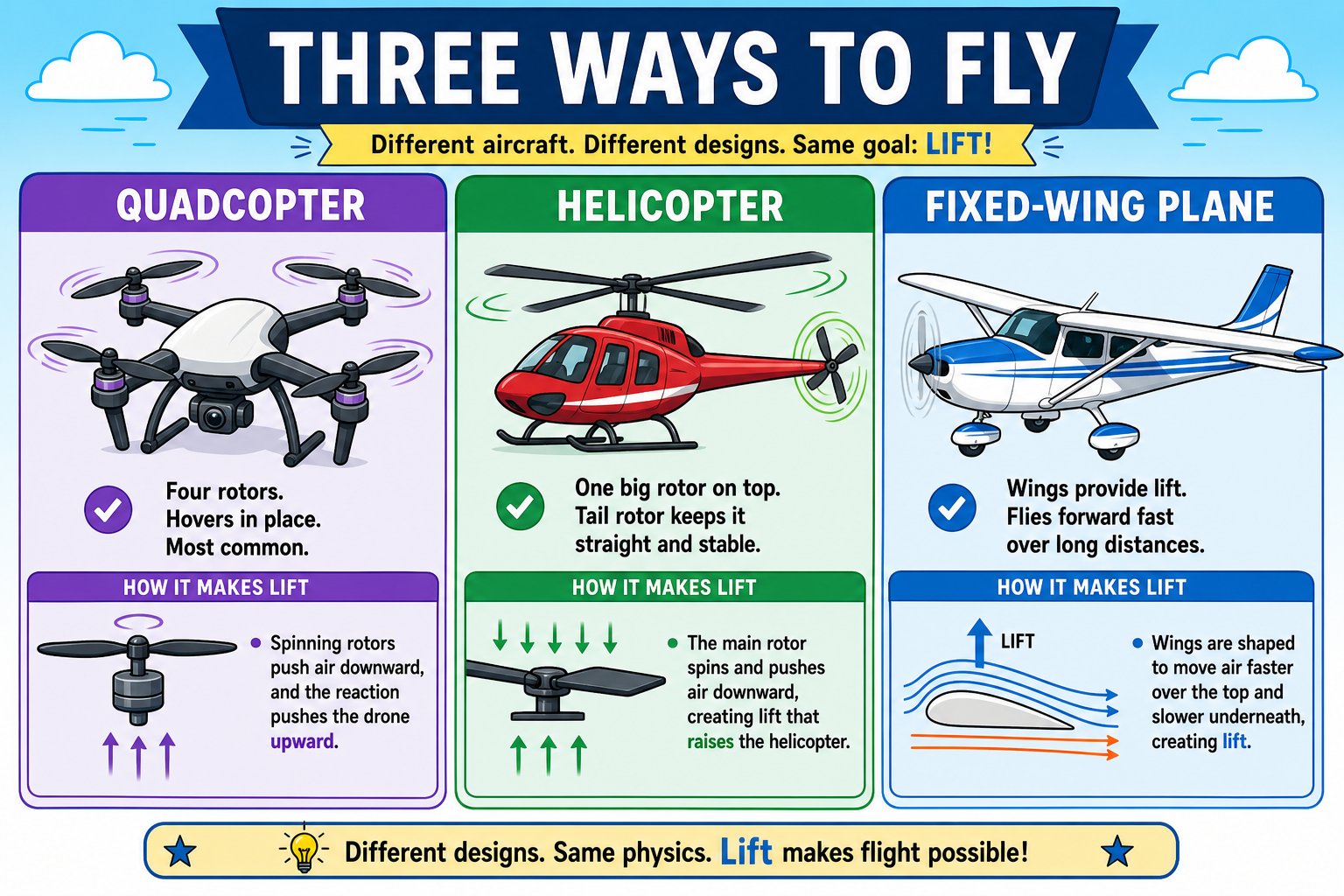
Three designs, same goal: make enough lift to beat gravity
Your Echo is a quadcopter, so it can hover perfectly still in the air - something a fixed-wing plane can never do. That’s exactly what makes it great for indoor flying and coding precise moves.
Drones come in all sizes
Drones range from palm-sized toys to aircraft with wingspans wider than a school bus. Your Echo sits near the small, safe end - light enough to fly indoors and land on your hand.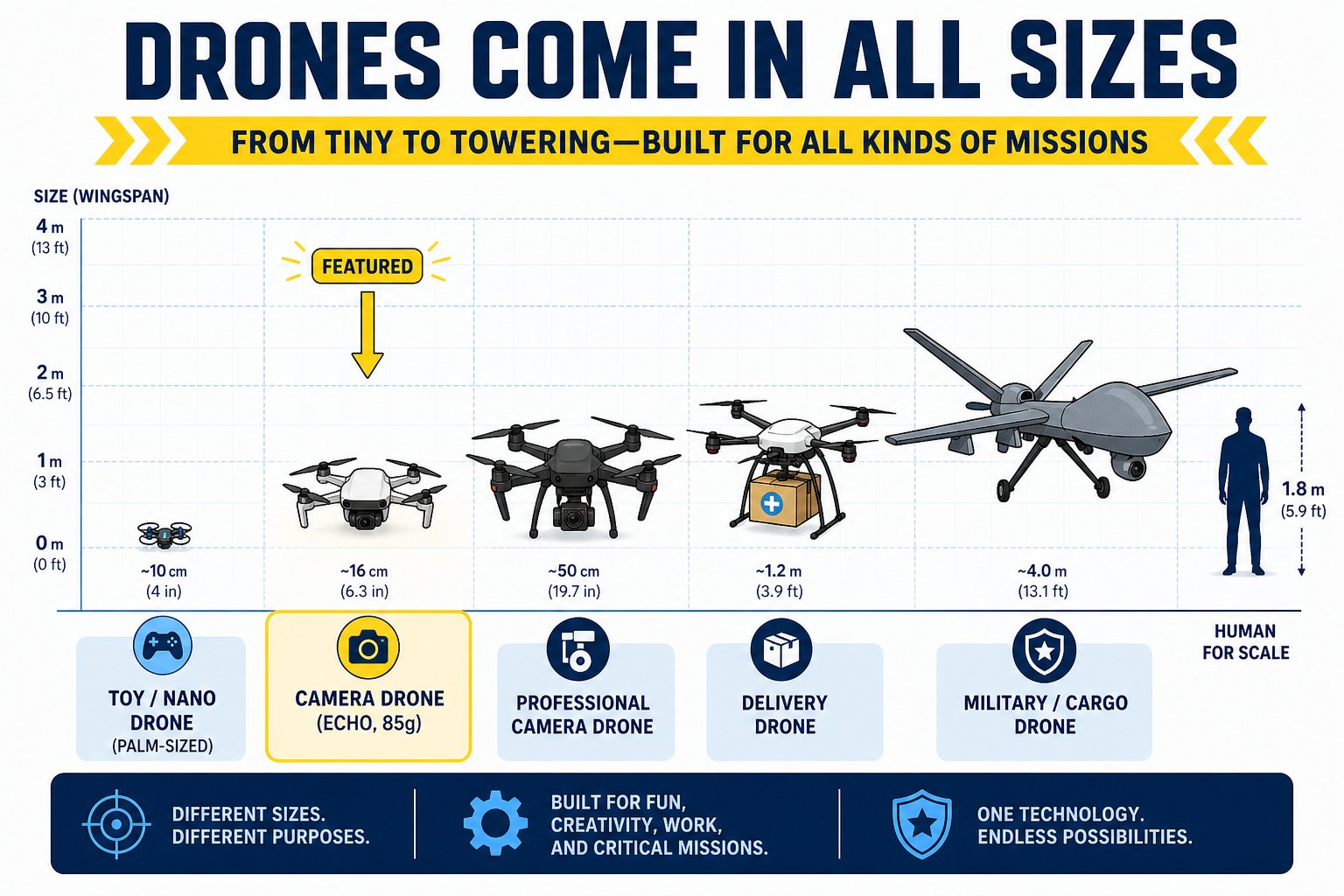
From nano toys to giant cargo drones - your Echo is on the small, safe end
Where drones are used
Drones started as military tools, but today they’re everywhere - doing jobs that are too dangerous, too expensive, or simply impossible for people.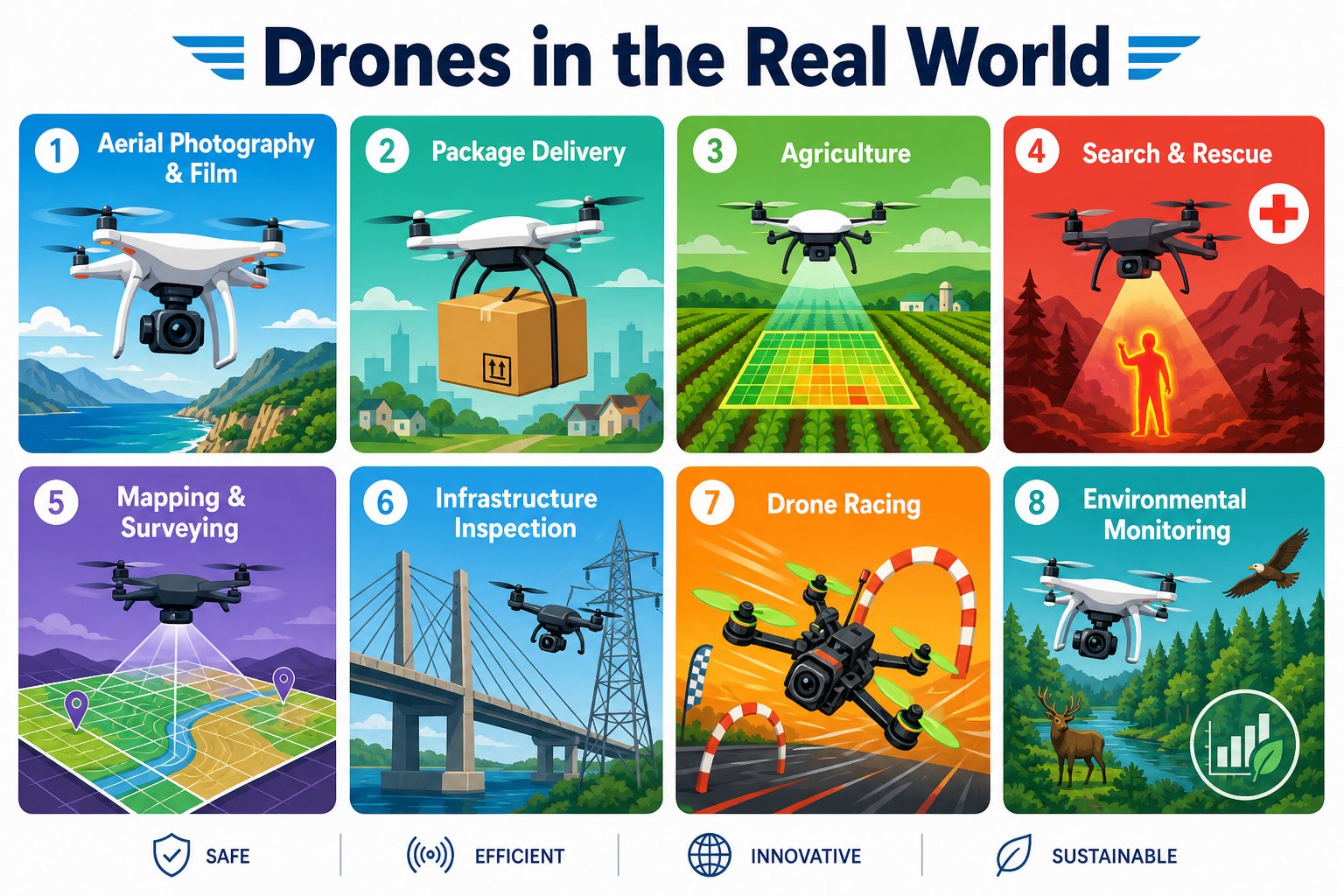
Drones do real work across dozens of industries
Film and photography
Film and photography
Sweeping aerial shots in movies, sports, and real estate that once needed a helicopter now come from a drone costing a tiny fraction as much.
Delivery
Delivery
Companies deliver medicine, food, and packages by drone - reaching remote areas in minutes instead of hours.
Agriculture
Agriculture
Farmers use drones to scan fields, spot sick crops, map water, and even spray precisely where it’s needed.
Search and rescue
Search and rescue
Thermal-camera drones find lost hikers and disaster survivors by their body heat, day or night.
Mapping and inspection
Mapping and inspection
Drones survey land, inspect bridges, cell towers, and power lines, and build 3D maps - keeping humans off ladders and out of danger.
Science and conservation
Science and conservation
Researchers track wildlife, monitor forests and glaciers, and study storms without disturbing the environment.
Why drones matter
Drones combine several technologies you’ll touch this week - flight, sensors, cameras, wireless communication, and computer vision. Learning to program one means learning how modern autonomous machines actually work, from self-driving cars to warehouse robots.Talk about it
Great discussion questions to run with your group:Helpful or harmful?
Name one way drones help people and one way they could be misused. How do we get the good without the bad?
Spot the drone job
What’s a job in your town a drone could do better, cheaper, or more safely?
You can explain that a drone is an unmanned aircraft, name the four things every drone needs, compare a quadcopter to a plane, and give three real-world uses.