

More than one way to print
Your Ender 3 uses FDM, but it is just one member of a bigger family. Knowing the others helps you understand what 3D printing can do and choose the right tool for a job.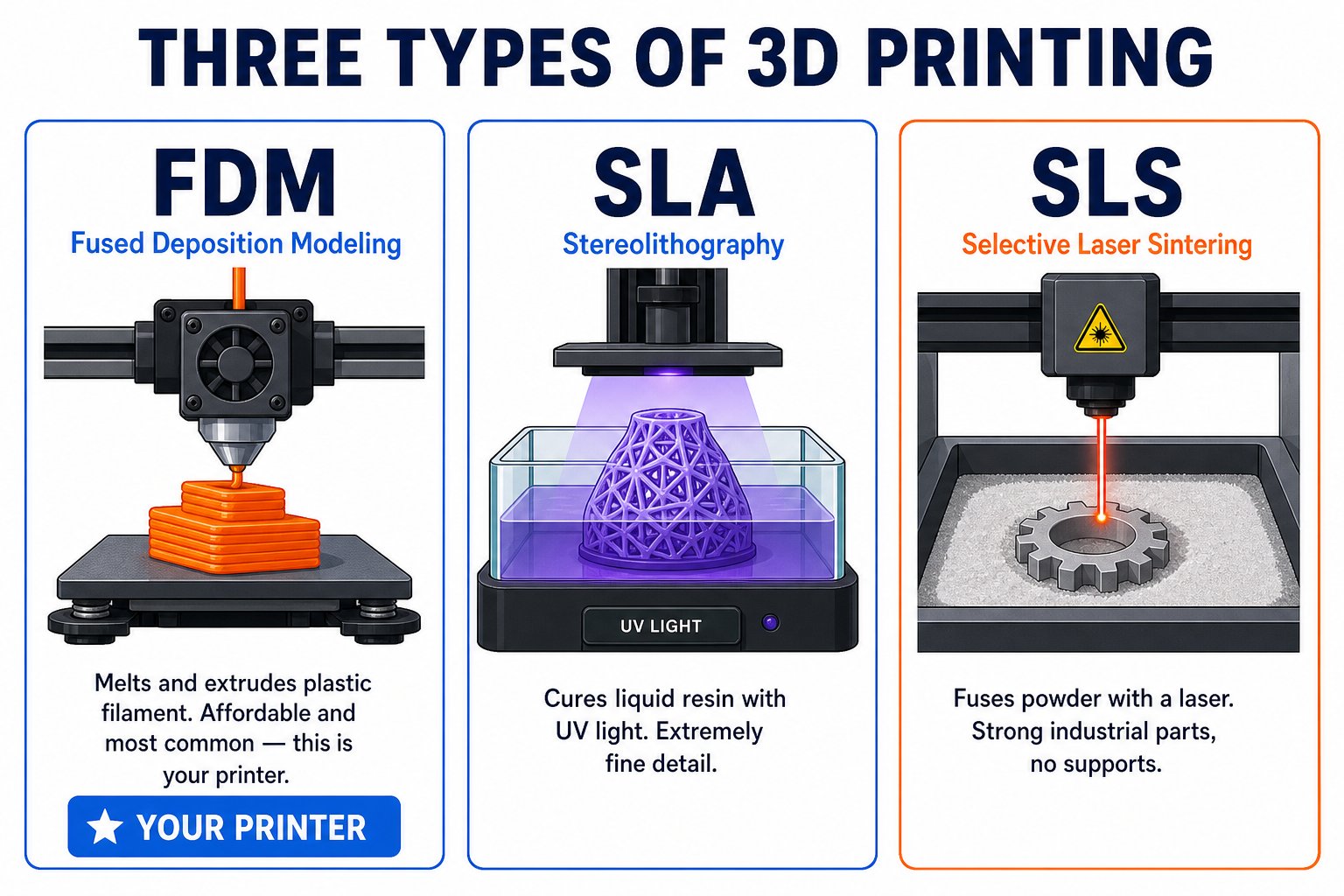
The three most common 3D printing technologies
The three main technologies
FDM - Fused Deposition Modeling
FDM - Fused Deposition Modeling
Melts thermoplastic filament and extrudes it through a nozzle, layer by layer. It has the lowest cost of entry and is the most common desktop method - this is your Ender 3. Trade-off: lower resolution than resin.
SLA - Stereolithography
SLA - Stereolithography
Uses a UV laser or light to cure liquid resin, solidifying it layer by layer. Produces the finest detail and smoothest surfaces - ideal for miniatures, jewelry, and dental models. Trade-off: messy resin and post-curing.
SLS - Selective Laser Sintering
SLS - Selective Laser Sintering
Uses a high-powered laser to fuse powdered nylon or metal. The surrounding powder supports the part, so no support structures are needed. Produces strong, functional parts. Trade-off: industrial and expensive.
Additive vs subtractive
All 3D printing is additive - you add material to build a shape. Traditional manufacturing is often subtractive - you cut material away from a solid block.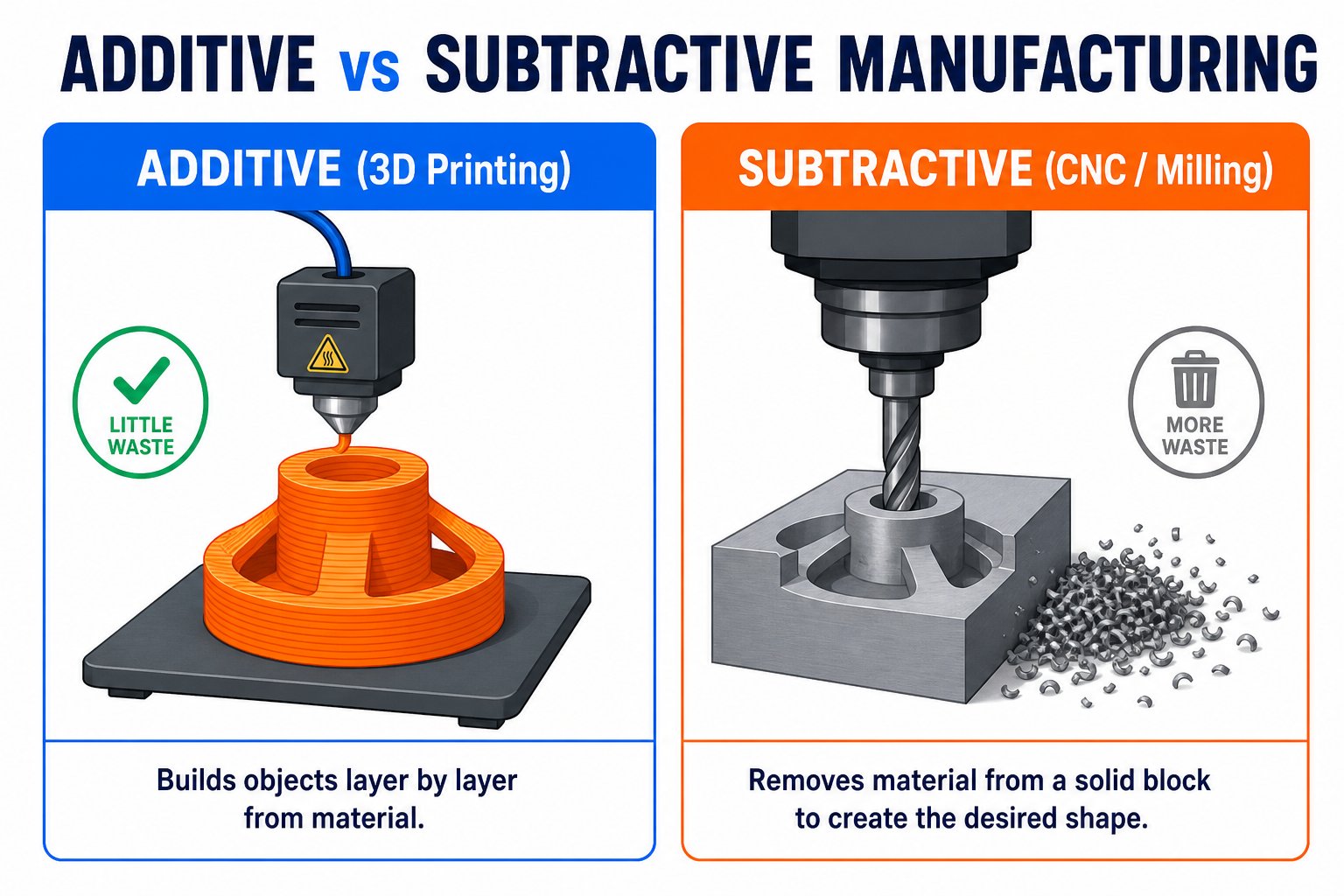
Additive builds up; subtractive carves away
Common printing materials
Plastics
PLA, ABS, PETG, and more. Affordable, versatile, and used in most desktop printing.
Metals
Powdered steel, titanium, or aluminum, fused for strong industrial parts.
Ceramics & more
Ceramic powders, resins, and even edible or concrete materials for special uses.
Kinds of 3D printers
- Desktop
- Industrial
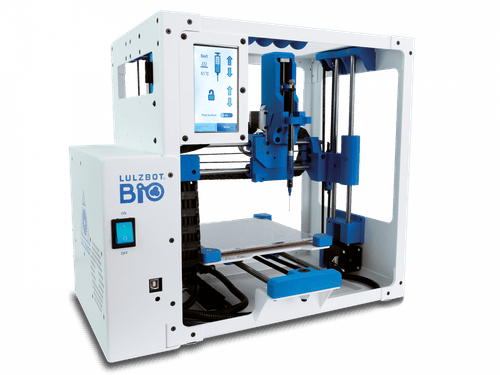
- Specialized
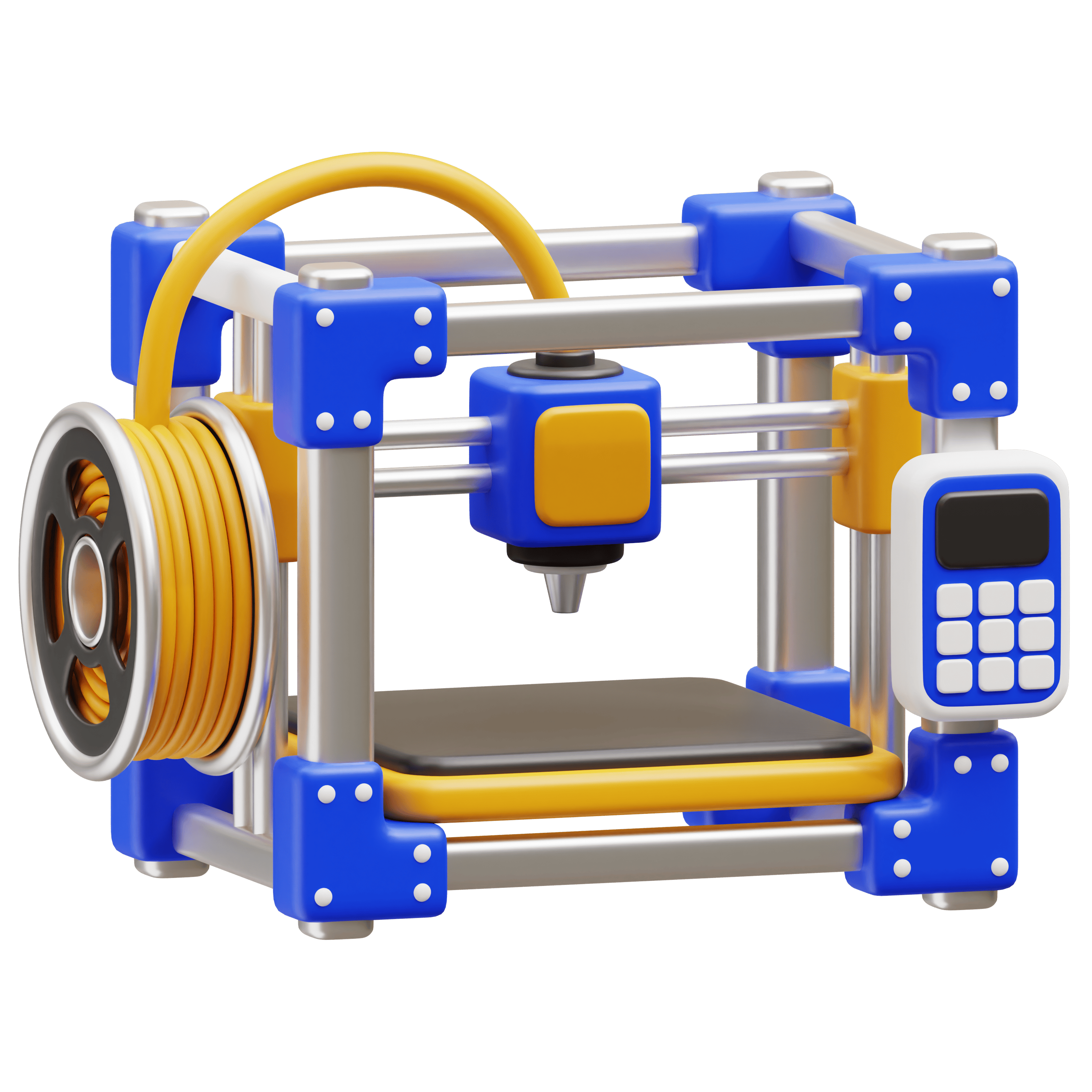
Compact, affordable printers for homes, schools, and hobbyists. Usually FDM. Your Ender 3 is a desktop printer.
Where 3D printing is used
From classrooms to operating rooms, 3D printing shows up across nearly every industry.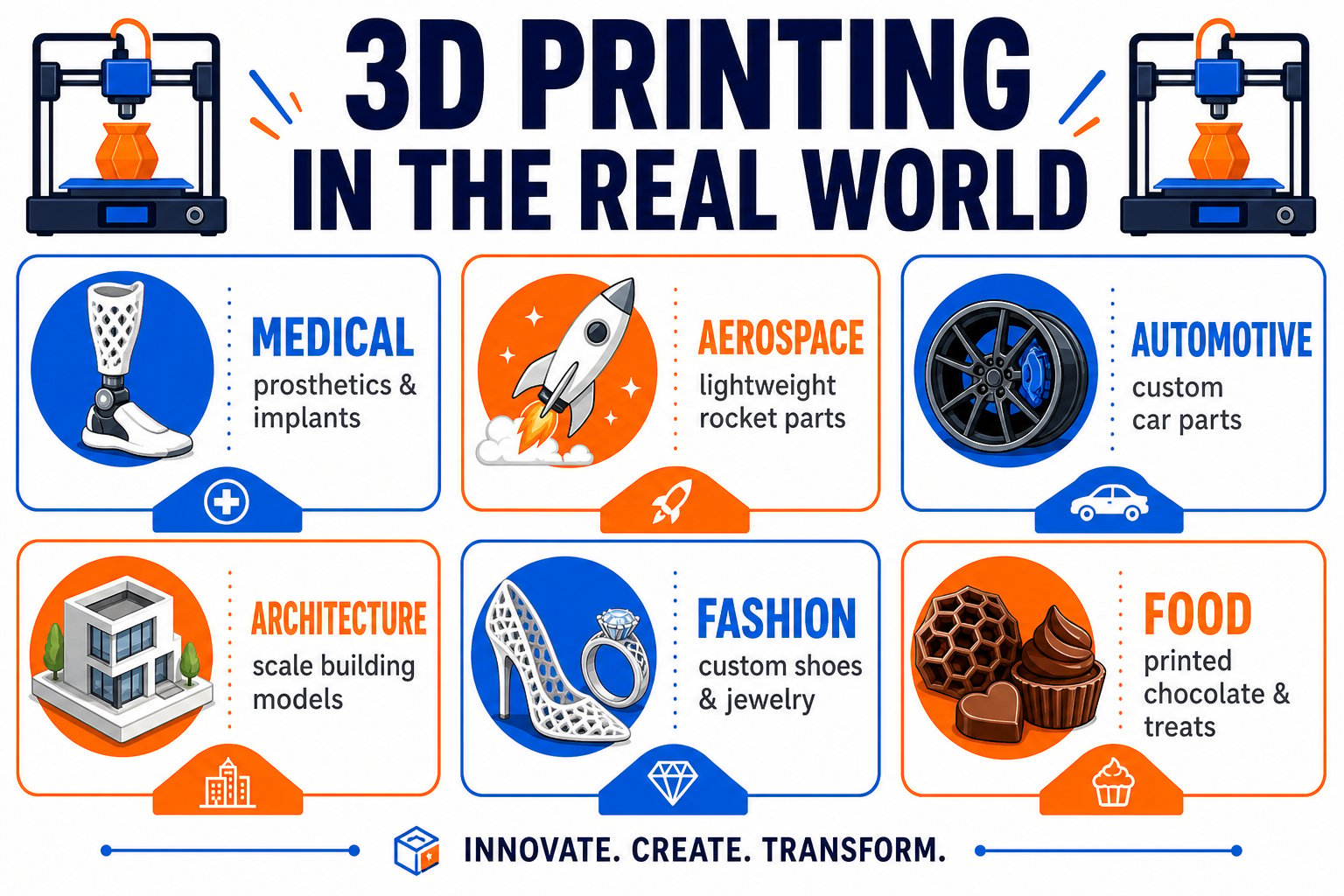
3D printing is transforming industries from healthcare to aerospace to education
Where the technology is going
Multi-material & multi-color
Printing several colors or materials in one object for vivid, functional parts.
High-speed printing
Faster machines that print in a fraction of the time without losing quality.
Bioprinting
Printing tissue, implants, and one day whole organs for medicine.
Construction
Printing houses and bridges from concrete, faster and cheaper than traditional building.