> ## Documentation Index
> Fetch the complete documentation index at: https://stem-docs.intellectualpoint.com/llms.txt
> Use this file to discover all available pages before exploring further.
# Types of drones
> Compare the main drone designs - from quadcopters to fixed-wing - and learn why each shape suits a different job.
## One idea, many shapes
All drones fly without a pilot on board, but they come in very different shapes. The design decides how long it flies, how much it carries, and what it's good at.
 ## The main designs
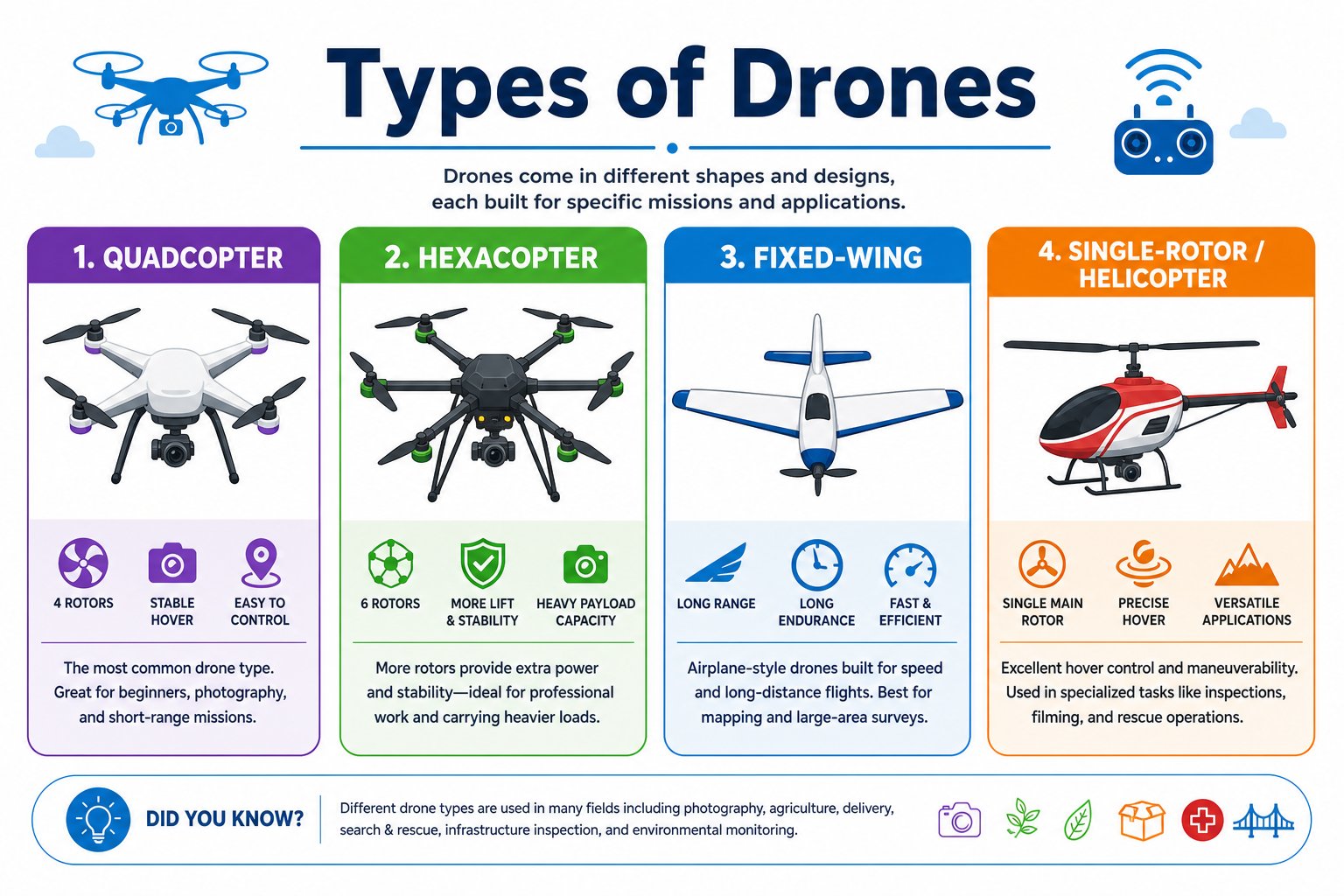
**Four rotors.** The most common design and the one you're building.
* **Strengths**: Simple, stable, hovers in place, easy to control, cheap
* **Trade-offs**: Shorter flight time, limited payload
* **Used for**: Learning, photography, racing, inspection, most consumer drones
**Six or eight rotors.** More motors mean more lift and safety.
* **Strengths**: Carries heavy cameras and gear, keeps flying if one motor fails
* **Trade-offs**: Bigger, heavier, more expensive, uses more power
* **Used for**: Professional film, industrial lifting, mapping
**Shaped like an airplane.** Wings create lift, so it glides efficiently.
* **Strengths**: Long range and flight time, covers large areas fast
* **Trade-offs**: Can't hover, needs space to launch and land
* **Used for**: Farm and land surveying, mapping, long patrols
**One big main rotor** plus a tail rotor.
* **Strengths**: Very efficient hovering, can carry heavy loads
* **Trade-offs**: Complex, harder to fly, larger moving blades
* **Used for**: Specialized heavy-lift and long-endurance tasks
## How to pick a design
The right drone depends on the mission. Engineers weigh three questions:
## The main designs
**Four rotors.** The most common design and the one you're building.
* **Strengths**: Simple, stable, hovers in place, easy to control, cheap
* **Trade-offs**: Shorter flight time, limited payload
* **Used for**: Learning, photography, racing, inspection, most consumer drones
**Six or eight rotors.** More motors mean more lift and safety.
* **Strengths**: Carries heavy cameras and gear, keeps flying if one motor fails
* **Trade-offs**: Bigger, heavier, more expensive, uses more power
* **Used for**: Professional film, industrial lifting, mapping
**Shaped like an airplane.** Wings create lift, so it glides efficiently.
* **Strengths**: Long range and flight time, covers large areas fast
* **Trade-offs**: Can't hover, needs space to launch and land
* **Used for**: Farm and land surveying, mapping, long patrols
**One big main rotor** plus a tail rotor.
* **Strengths**: Very efficient hovering, can carry heavy loads
* **Trade-offs**: Complex, harder to fly, larger moving blades
* **Used for**: Specialized heavy-lift and long-endurance tasks
## How to pick a design
The right drone depends on the mission. Engineers weigh three questions:
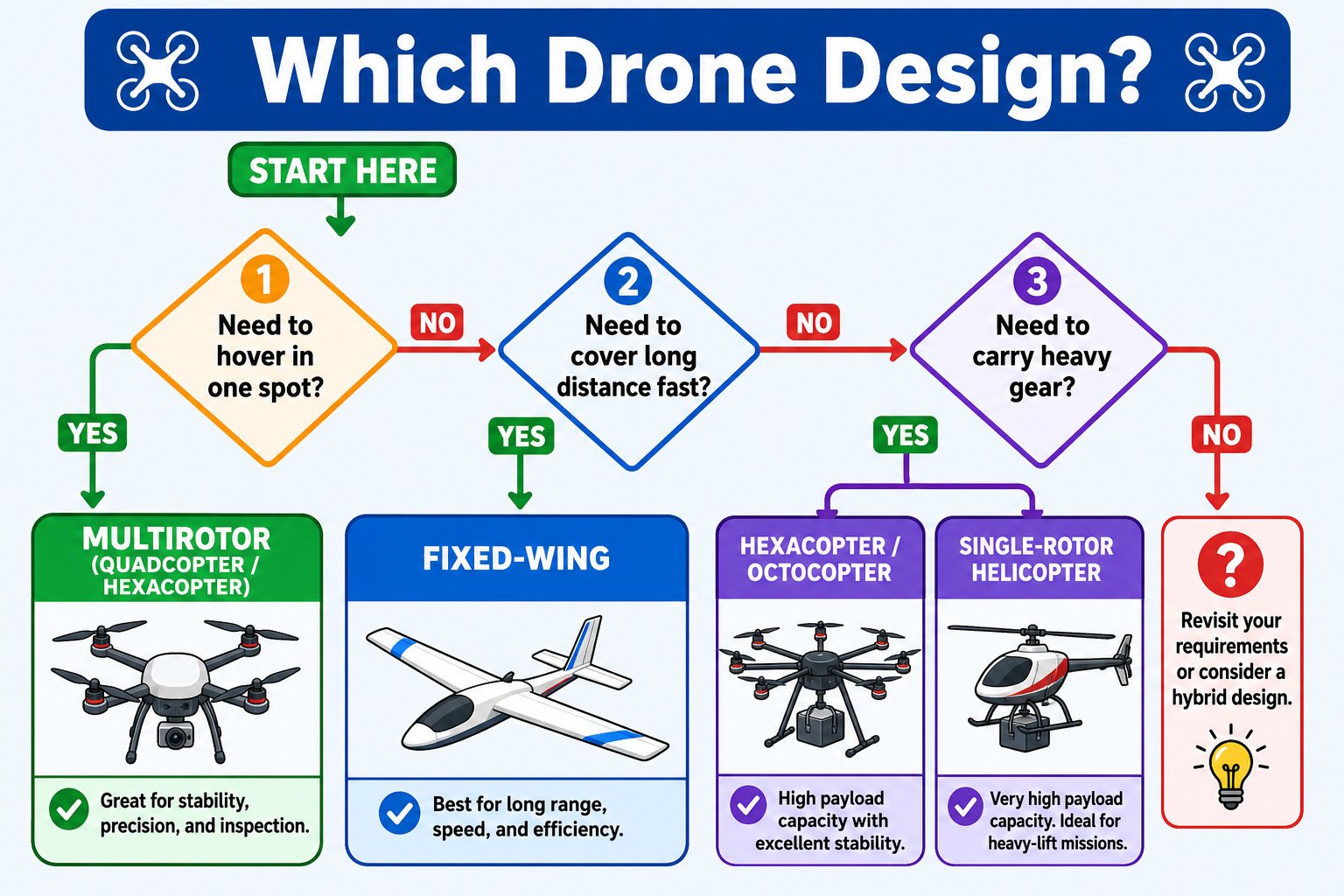 Need to stay still over one spot? Choose rotors. Need to cover distance? Choose wings.
Heavier cameras and cargo need more or bigger rotors for extra lift.
Fixed-wing drones fly far longer; multirotors trade endurance for control.
## Why a quadcopter for learning?
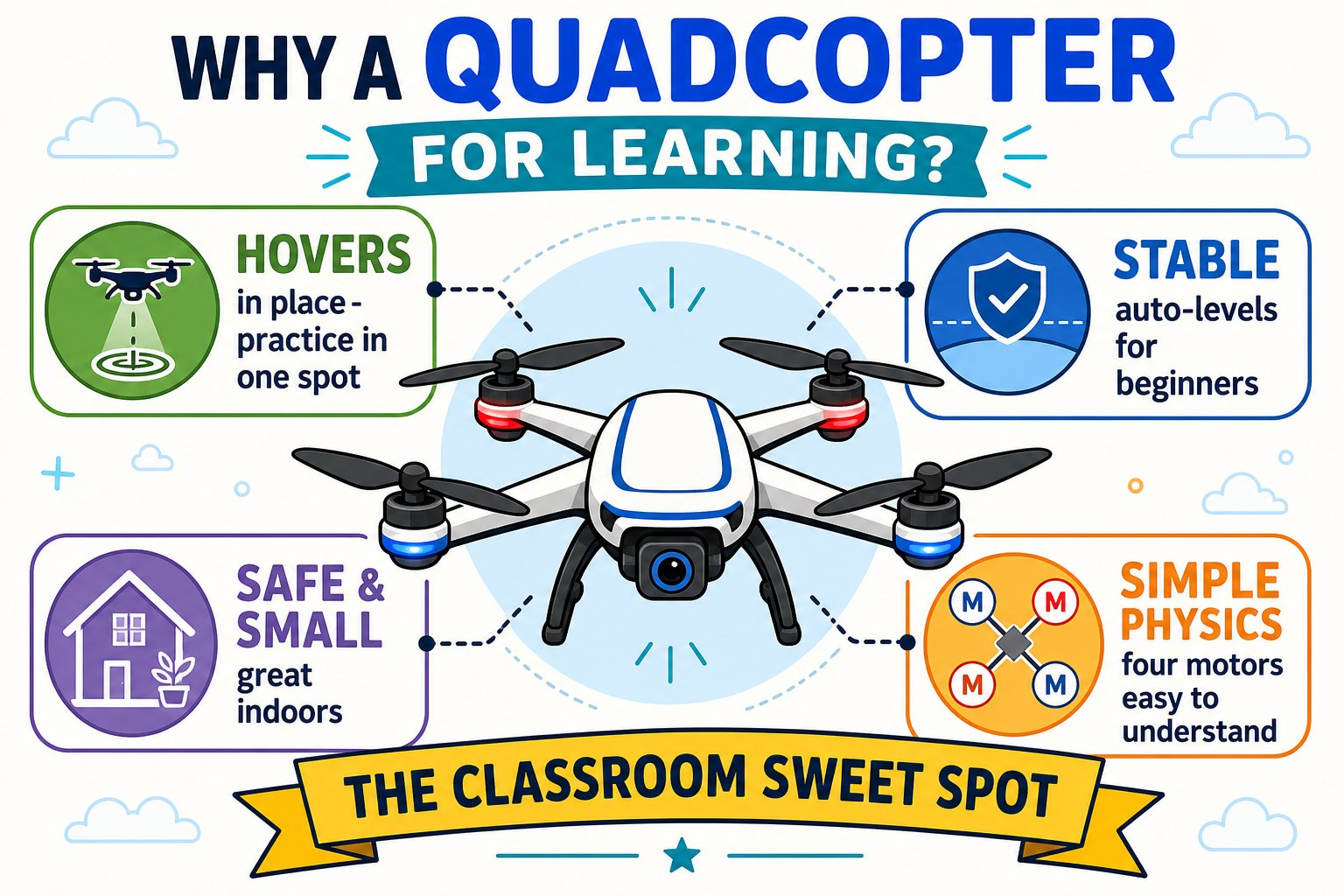
The quadcopter hits the sweet spot for a classroom: it hovers so you can practice in one spot, it's stable enough for beginners, it's small and safe indoors, and its four-motor layout makes the physics of flight easy to see and understand.
Need to stay still over one spot? Choose rotors. Need to cover distance? Choose wings.
Heavier cameras and cargo need more or bigger rotors for extra lift.
Fixed-wing drones fly far longer; multirotors trade endurance for control.
## Why a quadcopter for learning?
The quadcopter hits the sweet spot for a classroom: it hovers so you can practice in one spot, it's stable enough for beginners, it's small and safe indoors, and its four-motor layout makes the physics of flight easy to see and understand.
 Watch how your Echo Drone stays level when you let go of the sticks. That "auto-hover" is the flight controller adjusting all four motors many times a second - the single biggest reason quadcopters are easy to fly.
You can name the four main drone types and explain why a quadcopter is the best choice for learning to fly and code.
Watch how your Echo Drone stays level when you let go of the sticks. That "auto-hover" is the flight controller adjusting all four motors many times a second - the single biggest reason quadcopters are easy to fly.
You can name the four main drone types and explain why a quadcopter is the best choice for learning to fly and code.