> ## Documentation Index
> Fetch the complete documentation index at: https://stem-docs.intellectualpoint.com/llms.txt
> Use this file to discover all available pages before exploring further.
# A short history of drones
> Trace the drone from wartime target planes to the pocket-sized flying computers of today - and see why the one on your desk is a small miracle.
## From balloons to quadcopters
Drones feel like brand-new technology, but the idea of unmanned flight is over 170 years old. The story is one of steadily shrinking size and growing intelligence - ending with the little quadcopter on your desk.
 ## The timeline
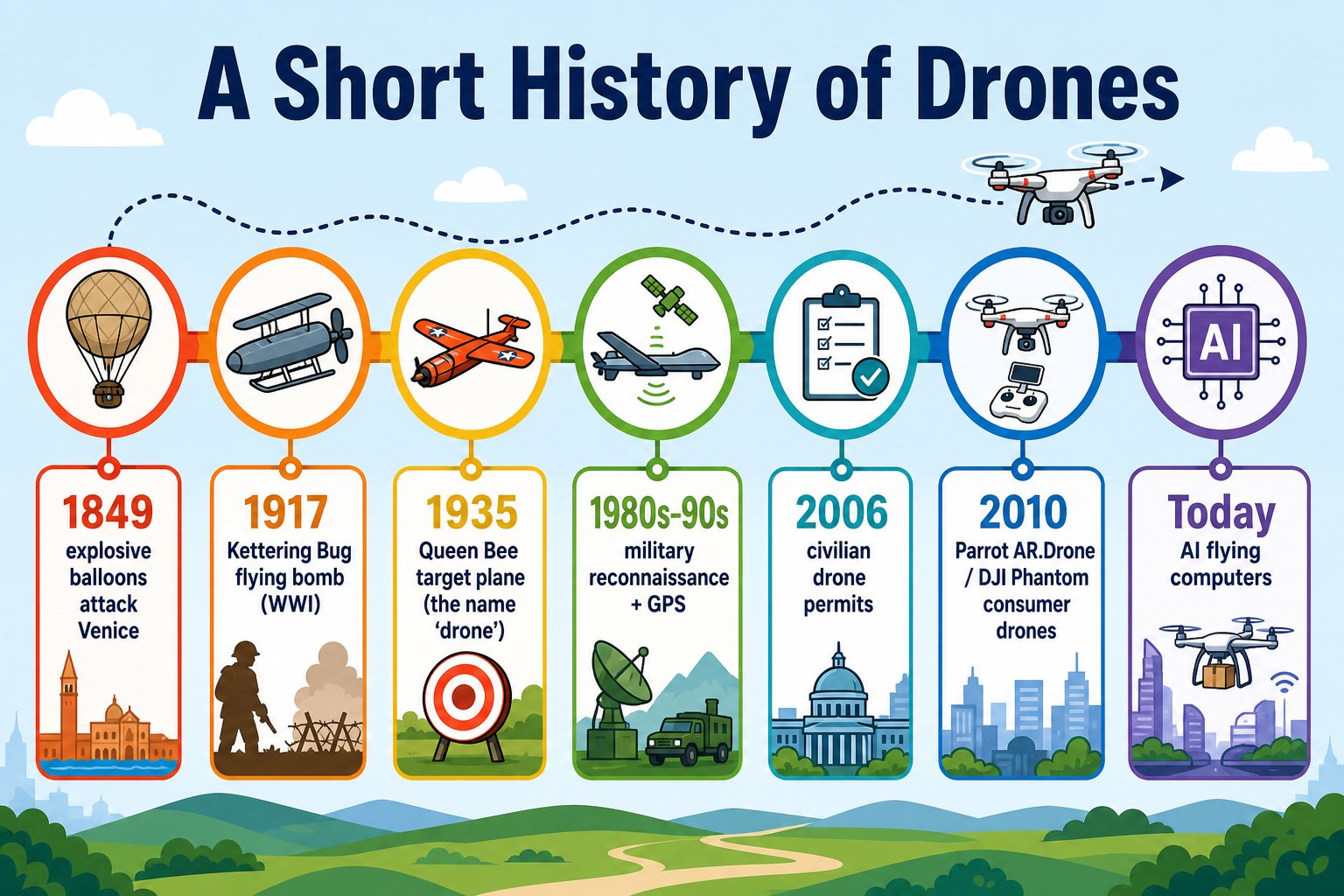
Austria launched unmanned balloons loaded with explosives at Venice. Crude and wind-dependent, but the first "unmanned aerial vehicle" in history.
During World War I, engineers built the first radio-controlled and gyroscope-stabilized aircraft, like the Kettering Bug - flying bombs guided without a pilot.
The British "Queen Bee" radio-controlled target plane gave us the modern word "drone." They were used to train anti-aircraft gunners.
Drones became reconnaissance tools, carrying cameras over battlefields. GPS made them far more capable and precise.
Governments began issuing commercial drone permits, opening the door for farming, mapping, and film use.
The Parrot AR.Drone flew from a smartphone. Soon after, DJI's Phantom put an easy-to-fly camera drone in millions of hands.
Modern drones carry powerful processors, AI cameras, and sensors. They deliver packages, inspect infrastructure, and - like yours - run code students write.
## What changed?
Three breakthroughs turned drones from clumsy machines into the smart, stable devices we have today:
Cheap gyroscopes and accelerometers (the same ones in your phone) let a drone balance itself hundreds of times per second.
Lightweight lithium batteries pack enough energy to keep motors spinning for a real flight.
Flight controllers do the constant math of staying level, freeing the pilot to just say "go there."
## Then vs. now
The drone in your hands would have been science fiction to engineers in the 1990s - and it costs less than a video game console.
## The timeline
Austria launched unmanned balloons loaded with explosives at Venice. Crude and wind-dependent, but the first "unmanned aerial vehicle" in history.
During World War I, engineers built the first radio-controlled and gyroscope-stabilized aircraft, like the Kettering Bug - flying bombs guided without a pilot.
The British "Queen Bee" radio-controlled target plane gave us the modern word "drone." They were used to train anti-aircraft gunners.
Drones became reconnaissance tools, carrying cameras over battlefields. GPS made them far more capable and precise.
Governments began issuing commercial drone permits, opening the door for farming, mapping, and film use.
The Parrot AR.Drone flew from a smartphone. Soon after, DJI's Phantom put an easy-to-fly camera drone in millions of hands.
Modern drones carry powerful processors, AI cameras, and sensors. They deliver packages, inspect infrastructure, and - like yours - run code students write.
## What changed?
Three breakthroughs turned drones from clumsy machines into the smart, stable devices we have today:
Cheap gyroscopes and accelerometers (the same ones in your phone) let a drone balance itself hundreds of times per second.
Lightweight lithium batteries pack enough energy to keep motors spinning for a real flight.
Flight controllers do the constant math of staying level, freeing the pilot to just say "go there."
## Then vs. now
The drone in your hands would have been science fiction to engineers in the 1990s - and it costs less than a video game console.
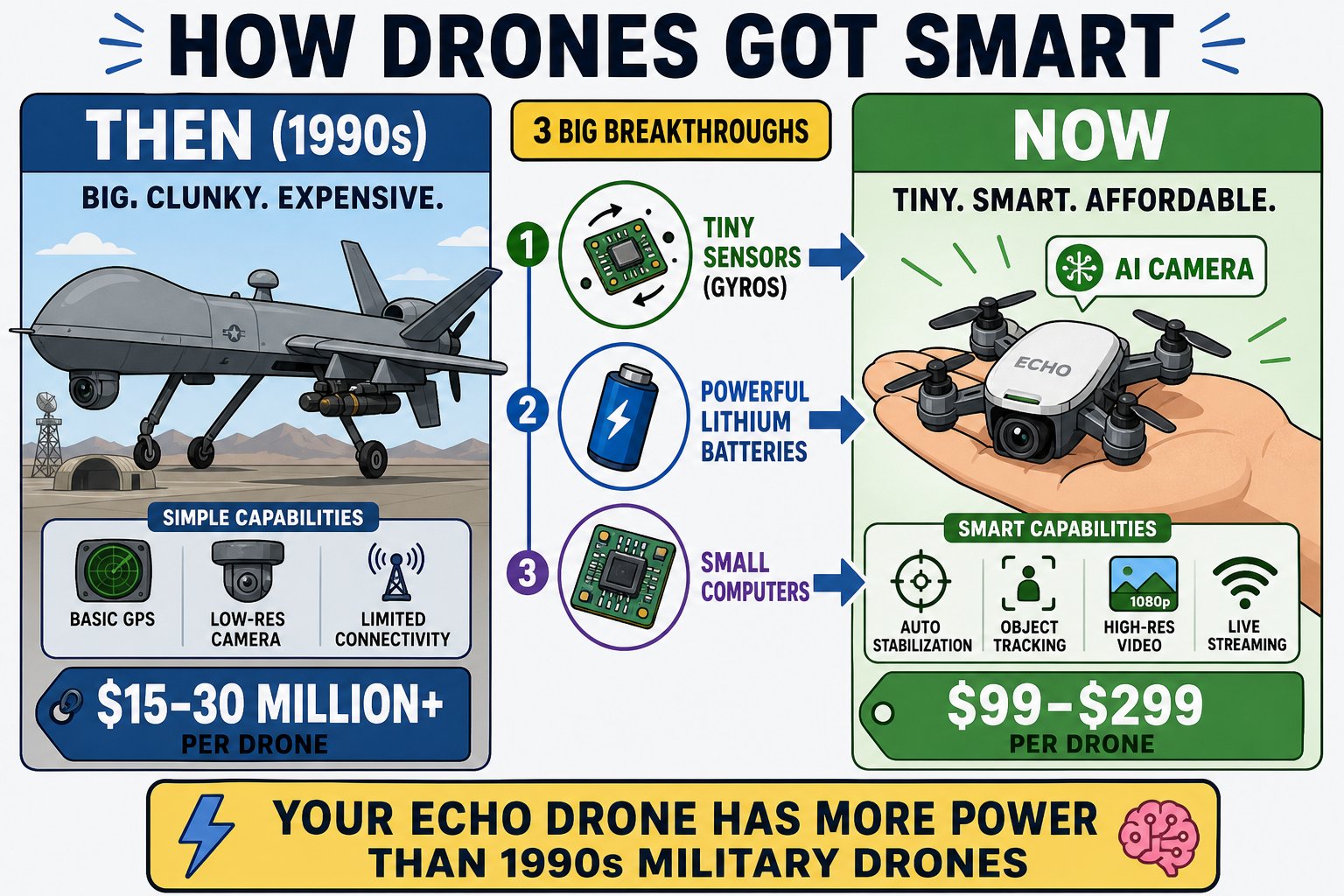 Your Echo Drone contains more computing power and better sensors than the multi-million-dollar military drones of the 1990s - and it fits in your hand.
## Where drones go next
The story isn't over - and you might help write the next chapter.
Medicine and packages delivered by autonomous fleets, especially to hard-to-reach places.
Drones that navigate, avoid obstacles, and make decisions with onboard AI.
Hundreds of drones flying together as one - for light shows, mapping, or search.
Larger passenger-carrying drones that could reshape how cities move.
## Think about it
Of the three breakthroughs (sensors, batteries, computers), which do you think mattered most - and why?
What's one thing today's drones still *can't* do well that you'd love to fix?
You can describe how drones evolved from wind-blown balloons to today's AI-powered flying computers, and name the three breakthroughs that made modern drones possible.
Your Echo Drone contains more computing power and better sensors than the multi-million-dollar military drones of the 1990s - and it fits in your hand.
## Where drones go next
The story isn't over - and you might help write the next chapter.
Medicine and packages delivered by autonomous fleets, especially to hard-to-reach places.
Drones that navigate, avoid obstacles, and make decisions with onboard AI.
Hundreds of drones flying together as one - for light shows, mapping, or search.
Larger passenger-carrying drones that could reshape how cities move.
## Think about it
Of the three breakthroughs (sensors, batteries, computers), which do you think mattered most - and why?
What's one thing today's drones still *can't* do well that you'd love to fix?
You can describe how drones evolved from wind-blown balloons to today's AI-powered flying computers, and name the three breakthroughs that made modern drones possible.