> ## Documentation Index
> Fetch the complete documentation index at: https://stem-docs.intellectualpoint.com/llms.txt
> Use this file to discover all available pages before exploring further.
# Battery and power
> Charge your drone the right way, read the battery lights, and care for your lithium battery so it lasts.
## Power is everything
A drone is only as good as its charge. Your Echo Drone flies on a small **lithium battery** that needs proper care to stay safe and last. Learning to charge and read it now means more flying time all week.
## Charging your drone battery
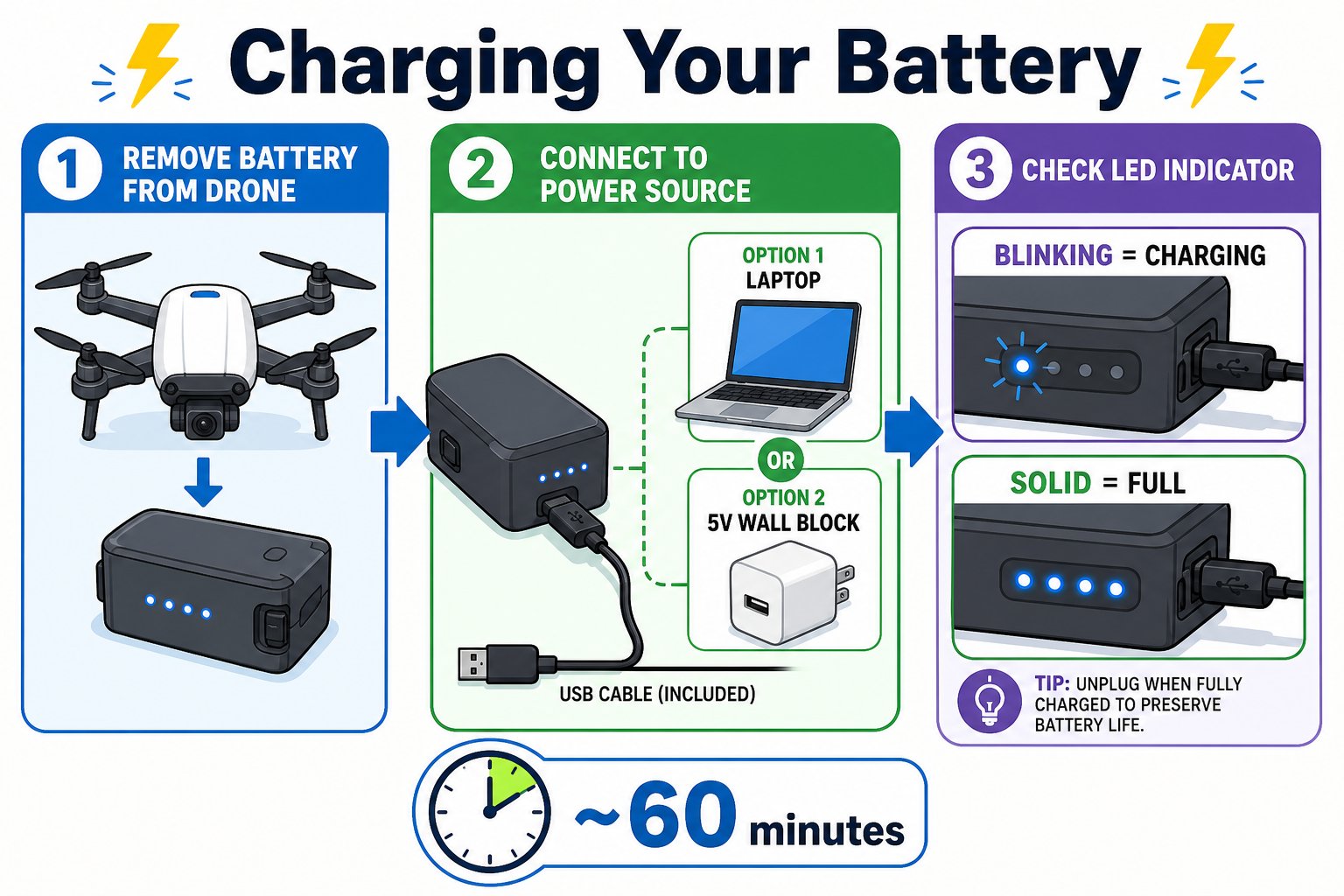 Slide the lithium battery out of the drone's body.
Plug one end of the USB cable into the battery, and the USB end into a computer or a 5 V wall block.
The battery's light **flashes while charging** and turns **solid when full**. A full charge takes about 60 minutes.
For best results, use the cable that came with your Echo Drone (or one with a USB "trident" mark). Poor-quality cables can charge slowly or unreliably.
## Battery and charging specs
| Spec | Value |
| -------------- | ---------------- |
| Battery type | Lithium (3.7 V) |
| Flight time | 9-10 minutes |
| Charging time | About 60 minutes |
| Charging input | 5 V |
| Full voltage | 4.2 V (±0.1 V) |
| Light blinking | Charging |
| Light solid | Charge complete |
## Reading the power signals
Your gear tells you when power is running low - learn the signals so you never lose a drone mid-flight.
Slide the lithium battery out of the drone's body.
Plug one end of the USB cable into the battery, and the USB end into a computer or a 5 V wall block.
The battery's light **flashes while charging** and turns **solid when full**. A full charge takes about 60 minutes.
For best results, use the cable that came with your Echo Drone (or one with a USB "trident" mark). Poor-quality cables can charge slowly or unreliably.
## Battery and charging specs
| Spec | Value |
| -------------- | ---------------- |
| Battery type | Lithium (3.7 V) |
| Flight time | 9-10 minutes |
| Charging time | About 60 minutes |
| Charging input | 5 V |
| Full voltage | 4.2 V (±0.1 V) |
| Light blinking | Charging |
| Light solid | Charge complete |
## Reading the power signals
Your gear tells you when power is running low - learn the signals so you never lose a drone mid-flight.
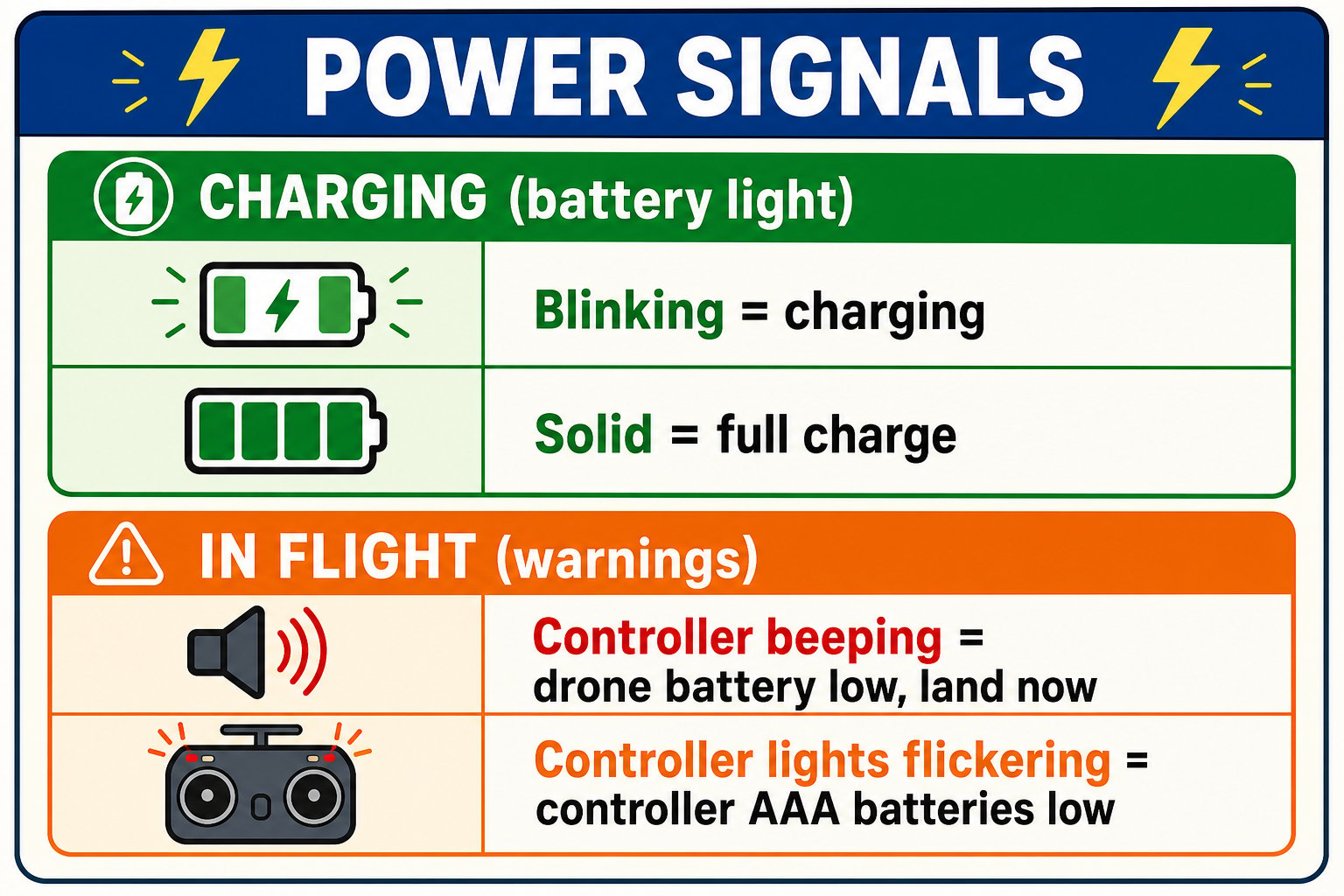 During flight, beeping means the **drone's battery** is dying. Land it and recharge.
Flickering indicator lights mean the **controller's AAA batteries** are dying and need replacing.
## Lithium battery safety
Lithium batteries are powerful and safe when treated correctly - but they demand respect. When in doubt, follow this simple **do / don't** guide.
During flight, beeping means the **drone's battery** is dying. Land it and recharge.
Flickering indicator lights mean the **controller's AAA batteries** are dying and need replacing.
## Lithium battery safety
Lithium batteries are powerful and safe when treated correctly - but they demand respect. When in doubt, follow this simple **do / don't** guide.
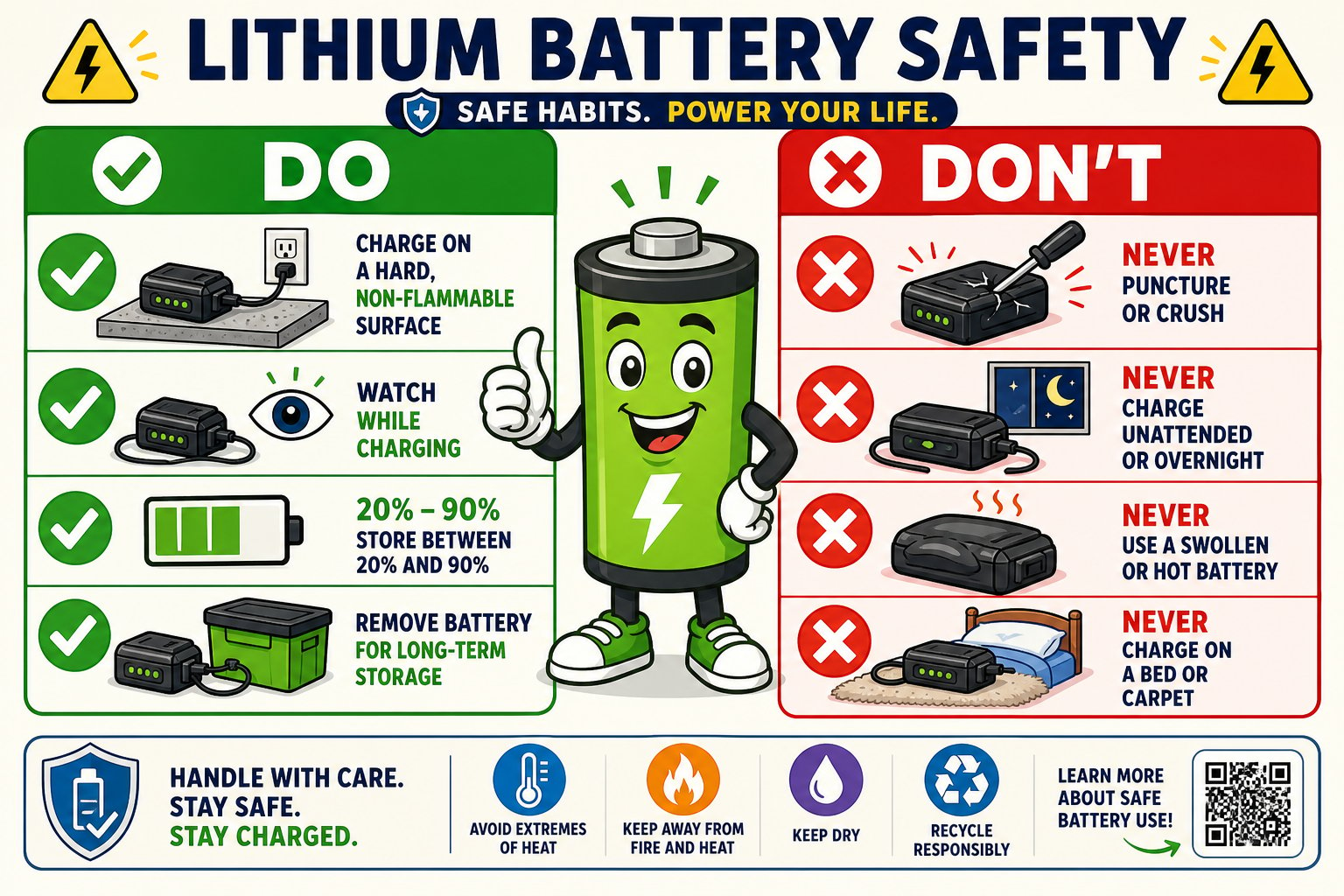 * **Never** puncture, crush, bend, or take apart the battery.
* **Never** charge it unattended or overnight.
* Stop using any battery that is **swollen, hot, or damaged** and tell your instructor.
* Charge on a hard, non-flammable surface - not on a bed or carpet.
* If storing the drone for a long time, **remove the battery** to protect its charge and prevent leakage.
## Make your battery last
A little care means many more flights over the life of your drone.
Land and swap at low power instead of flying until it dies.
Let a warm battery cool before charging or flying again.
For long storage, leave it around half full - not empty, not stuffed.
Fly, land, and swap to a charged battery rather than draining every battery to empty. Keeping lithium batteries between roughly 20% and 90% charge helps them last far longer.
## Do the math
A charge takes \~60 minutes and gives \~10 minutes of flight. How many chargers or spare batteries would keep one student flying non-stop for an hour?
If your class has 90 minutes of flying time, how will you schedule charging so no one is stuck waiting?
Your battery is fully charged (solid light), you know the two low-power warning signals, and you can state three lithium battery safety rules.
* **Never** puncture, crush, bend, or take apart the battery.
* **Never** charge it unattended or overnight.
* Stop using any battery that is **swollen, hot, or damaged** and tell your instructor.
* Charge on a hard, non-flammable surface - not on a bed or carpet.
* If storing the drone for a long time, **remove the battery** to protect its charge and prevent leakage.
## Make your battery last
A little care means many more flights over the life of your drone.
Land and swap at low power instead of flying until it dies.
Let a warm battery cool before charging or flying again.
For long storage, leave it around half full - not empty, not stuffed.
Fly, land, and swap to a charged battery rather than draining every battery to empty. Keeping lithium batteries between roughly 20% and 90% charge helps them last far longer.
## Do the math
A charge takes \~60 minutes and gives \~10 minutes of flight. How many chargers or spare batteries would keep one student flying non-stop for an hour?
If your class has 90 minutes of flying time, how will you schedule charging so no one is stuck waiting?
Your battery is fully charged (solid light), you know the two low-power warning signals, and you can state three lithium battery safety rules.