> ## Documentation Index
> Fetch the complete documentation index at: https://stem-docs.intellectualpoint.com/llms.txt
> Use this file to discover all available pages before exploring further.
# Drone Flight & Coding
> Build a real drone, learn to fly it like a pilot, then program it to fly on its own - from block coding to autonomous missions.
## Build it. Fly it. Code it.
Welcome to the **Drone Flight & Coding** STEM Workshop. Over five days you go from a boxed-up drone to a confident pilot who can program the drone to fly missions on its own - all with beginner-friendly block coding, no experience needed.
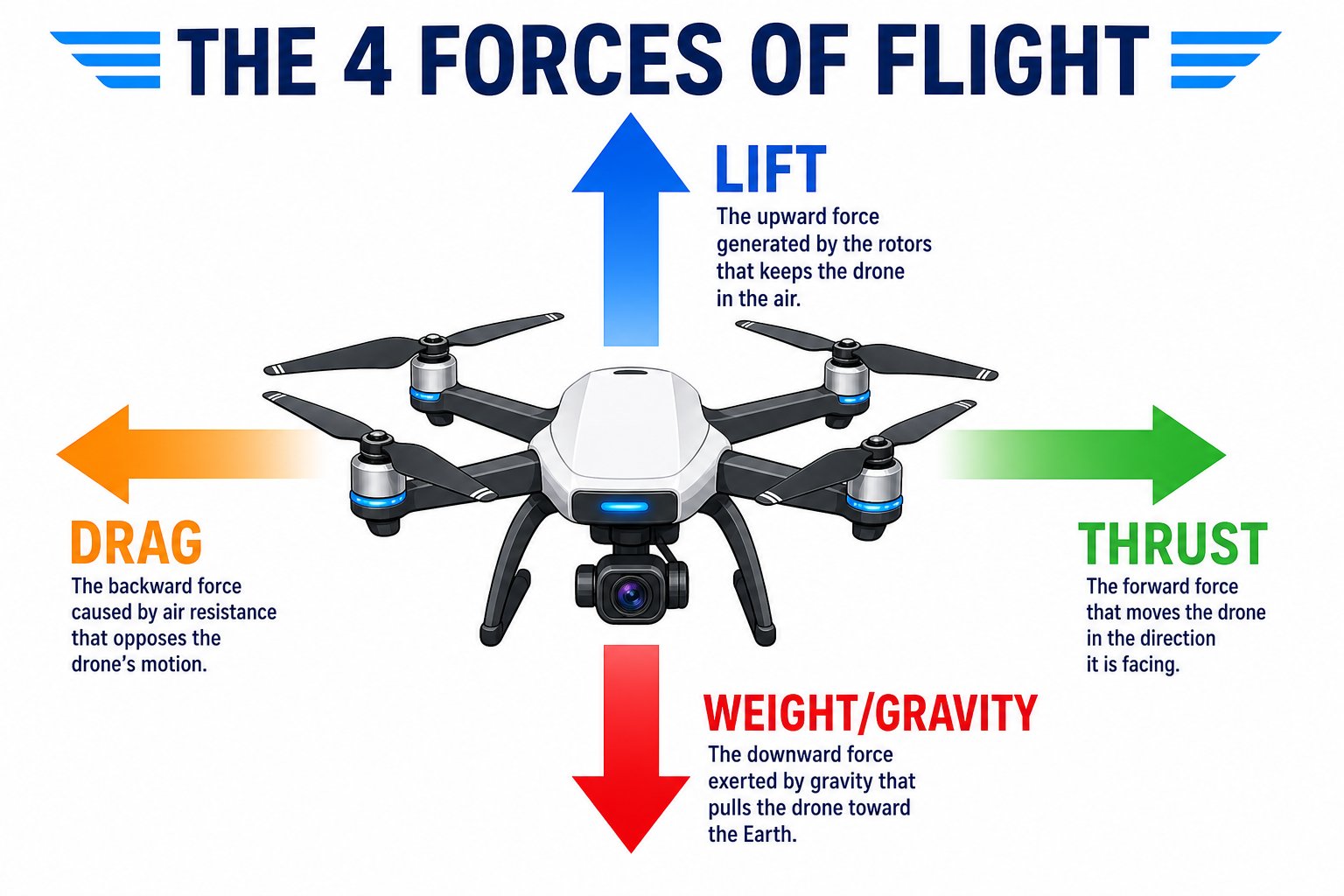 This is a fully virtual, facilitator-led camp. Every student gets a **Pitsco Echo Drone** to build, fly, and keep. For the coding days you'll use a laptop or Chromebook and, for the camera, a phone or tablet.
## What you'll do this week
* **Build** your Echo Drone and learn how drones fly
* **Fly** it by hand - hover, turn, and navigate with the controller
* **Code** it over Bluetooth with drag-and-drop blocks at echo.pitsco.com
* **See** through its camera with live first-person-view video
* **Program** more advanced autonomous missions with the AT-66BL app
* **Create** a capstone project and show it off
## Your week at a glance
Build your drone, learn how drones fly, and master flight safety.
Pair the controller, learn every control, and fly your first flights, plus more drone concepts.
Connect over Bluetooth and write your first block programs to fly the drone automatically.
Connect your phone to see the live camera, fly first-person-view, and explore more drone topics.
Use the AT-66BL app for more complex programs, then build and present your capstone.
## Meet the Echo Drone
The **Pitsco Echo Drone** is a classroom quadcopter built for learning. It's light (85 g), safe to fly indoors, needs no FAA registration, and can be flown three ways: with the **controller**, with **block/JavaScript code** over Bluetooth, and from the **camera app** over Wi-Fi.
| Feature | Spec |
| ------------- | ------------------------------------------ |
| Weight | 85 g (with battery) |
| Flight time | 9-10 minutes per charge |
| Camera | 720p, streams over Wi-Fi to the app |
| Control | Controller, Bluetooth coding, or Wi-Fi app |
| Battery | 3.7 V lithium, \~60 min charge |
| Stabilization | Optical-flow positioning sensor |
The evening before Day 1, charge your drone battery fully (the battery light turns solid when done) and put fresh AAA batteries in the controller. This saves time on the first morning.
## How the coding works
You'll program your drone two ways this week, both beginner-friendly:
* **echo.pitsco.com** (Day 3): a free website that connects to your drone over **Bluetooth**. You snap together blocks - or write JavaScript - to fly missions. Nothing to install.
* **AT-66BL app** (Day 5): a more advanced app that also connects over **Bluetooth**, with loops, events, sensors, variables, and custom blocks for more complex programs.
You're ready to start when your drone battery is charged, your controller has fresh AAA batteries, and you have a laptop/Chromebook (for coding) and a phone/tablet (for the camera).
This is a fully virtual, facilitator-led camp. Every student gets a **Pitsco Echo Drone** to build, fly, and keep. For the coding days you'll use a laptop or Chromebook and, for the camera, a phone or tablet.
## What you'll do this week
* **Build** your Echo Drone and learn how drones fly
* **Fly** it by hand - hover, turn, and navigate with the controller
* **Code** it over Bluetooth with drag-and-drop blocks at echo.pitsco.com
* **See** through its camera with live first-person-view video
* **Program** more advanced autonomous missions with the AT-66BL app
* **Create** a capstone project and show it off
## Your week at a glance
Build your drone, learn how drones fly, and master flight safety.
Pair the controller, learn every control, and fly your first flights, plus more drone concepts.
Connect over Bluetooth and write your first block programs to fly the drone automatically.
Connect your phone to see the live camera, fly first-person-view, and explore more drone topics.
Use the AT-66BL app for more complex programs, then build and present your capstone.
## Meet the Echo Drone
The **Pitsco Echo Drone** is a classroom quadcopter built for learning. It's light (85 g), safe to fly indoors, needs no FAA registration, and can be flown three ways: with the **controller**, with **block/JavaScript code** over Bluetooth, and from the **camera app** over Wi-Fi.
| Feature | Spec |
| ------------- | ------------------------------------------ |
| Weight | 85 g (with battery) |
| Flight time | 9-10 minutes per charge |
| Camera | 720p, streams over Wi-Fi to the app |
| Control | Controller, Bluetooth coding, or Wi-Fi app |
| Battery | 3.7 V lithium, \~60 min charge |
| Stabilization | Optical-flow positioning sensor |
The evening before Day 1, charge your drone battery fully (the battery light turns solid when done) and put fresh AAA batteries in the controller. This saves time on the first morning.
## How the coding works
You'll program your drone two ways this week, both beginner-friendly:
* **echo.pitsco.com** (Day 3): a free website that connects to your drone over **Bluetooth**. You snap together blocks - or write JavaScript - to fly missions. Nothing to install.
* **AT-66BL app** (Day 5): a more advanced app that also connects over **Bluetooth**, with loops, events, sensors, variables, and custom blocks for more complex programs.
You're ready to start when your drone battery is charged, your controller has fresh AAA batteries, and you have a laptop/Chromebook (for coding) and a phone/tablet (for the camera).