> ## Documentation Index
> Fetch the complete documentation index at: https://stem-docs.intellectualpoint.com/llms.txt
> Use this file to discover all available pages before exploring further.
# History of 3D printing
> From the first stereolithography patent to printed organs, cars, and affordable desktop printers like your Ender 3.
## Where did 3D printing come from?
3D printing feels modern, but the core ideas are over 40 years old. What started as an expensive industrial process for making quick prototypes has become a technology you can run on your desk. Understanding that journey helps you appreciate the machine you are about to build.
 ## The timeline
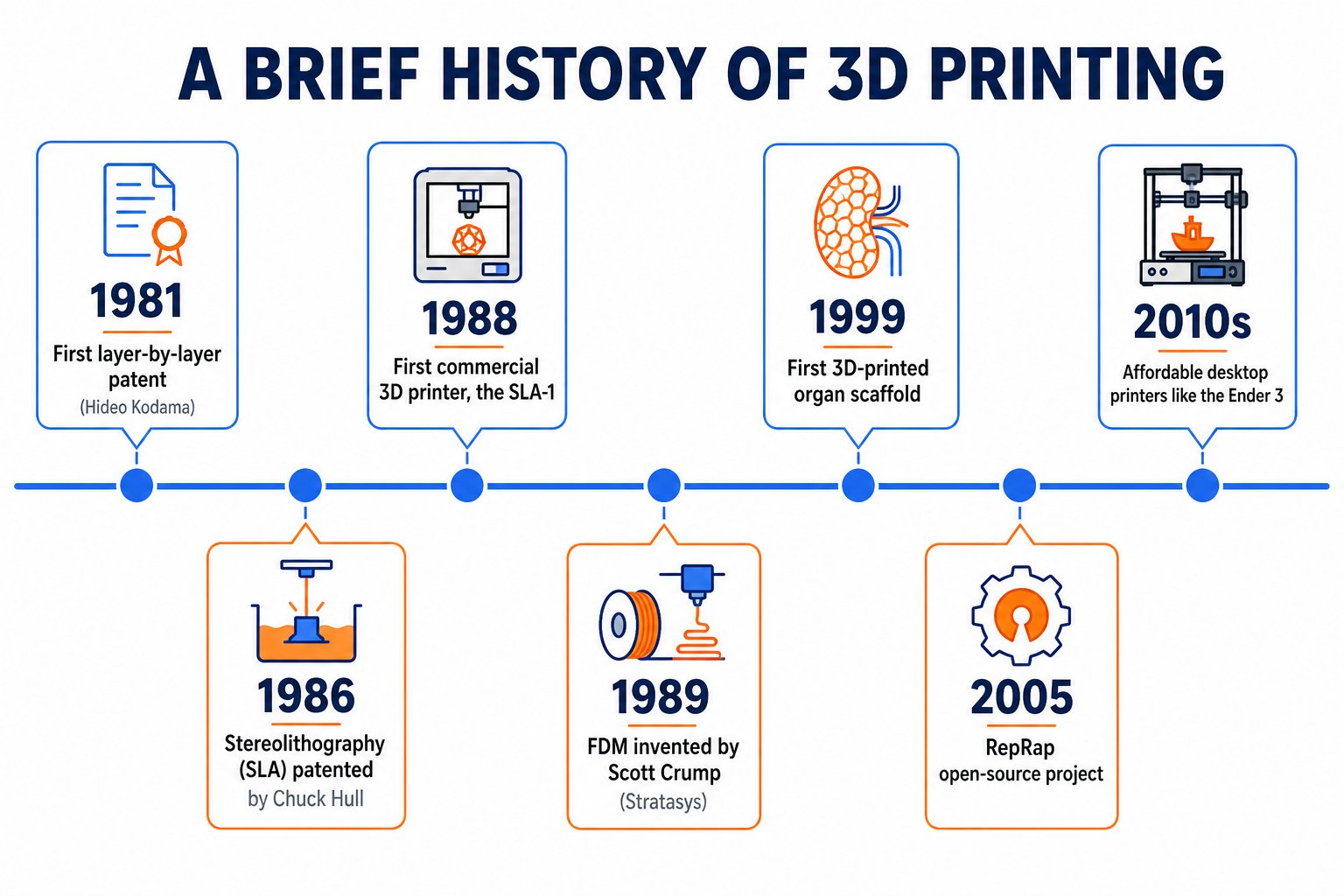
Dr. Hideo Kodama in Japan files some of the first patents describing a layer-by-layer photopolymer printing process - the earliest seeds of additive manufacturing.
Charles "Chuck" Hull patents **stereolithography (SLA)** and founds **3D Systems**. SLA uses a UV laser to cure liquid resin layer by layer. Hull also invents the **STL file format**, still used today.
3D Systems ships the **SLA-1**, the first commercially available 3D printer. It costs hundreds of thousands of dollars and is aimed at industrial prototyping.
Scott Crump patents **Fused Deposition Modeling (FDM)** and co-founds **Stratasys**. FDM melts and extrudes plastic filament - the exact technology in your Ender 3.
Scientists engineer a lab-grown human bladder using a 3D-printed scaffold, launching the field of **bioprinting**.
Dr. Adrian Bowyer launches **RepRap**, an open-source project to build self-replicating 3D printers. RepRap made FDM cheap and accessible and sparked the desktop 3D printing revolution.
As patents expired, companies released low-cost FDM printers. The **Creality Ender 3**, launched in 2018, became one of the best-selling 3D printers ever - the machine you are about to build.
## Why the RepRap project changed everything
Before 2005, 3D printers were locked behind patents and huge price tags. The **RepRap Project** released printer designs for free and encouraged people to build and improve them. Because early FDM patents began expiring around 2009, companies could suddenly sell affordable FDM printers.
Almost every hobbyist FDM printer today - including your Ender 3 - traces its lineage back to the open-source RepRap movement. The community spirit of "share and improve" is still alive in 3D printing.
## The main types of 3D printing
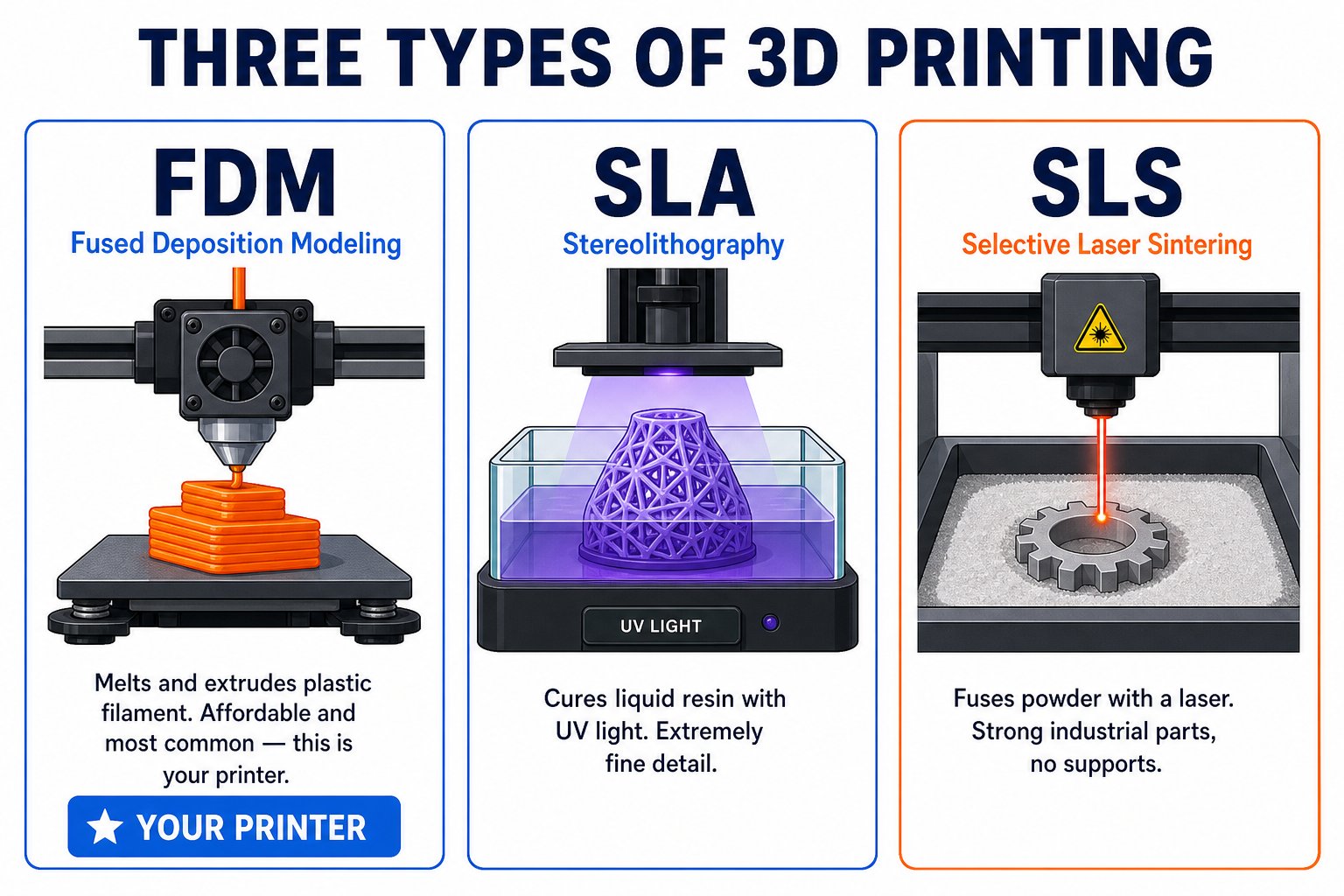
Your printer uses FDM, but it helps to know the wider family of technologies. You will explore these in more depth on Day 4.
## The timeline
Dr. Hideo Kodama in Japan files some of the first patents describing a layer-by-layer photopolymer printing process - the earliest seeds of additive manufacturing.
Charles "Chuck" Hull patents **stereolithography (SLA)** and founds **3D Systems**. SLA uses a UV laser to cure liquid resin layer by layer. Hull also invents the **STL file format**, still used today.
3D Systems ships the **SLA-1**, the first commercially available 3D printer. It costs hundreds of thousands of dollars and is aimed at industrial prototyping.
Scott Crump patents **Fused Deposition Modeling (FDM)** and co-founds **Stratasys**. FDM melts and extrudes plastic filament - the exact technology in your Ender 3.
Scientists engineer a lab-grown human bladder using a 3D-printed scaffold, launching the field of **bioprinting**.
Dr. Adrian Bowyer launches **RepRap**, an open-source project to build self-replicating 3D printers. RepRap made FDM cheap and accessible and sparked the desktop 3D printing revolution.
As patents expired, companies released low-cost FDM printers. The **Creality Ender 3**, launched in 2018, became one of the best-selling 3D printers ever - the machine you are about to build.
## Why the RepRap project changed everything
Before 2005, 3D printers were locked behind patents and huge price tags. The **RepRap Project** released printer designs for free and encouraged people to build and improve them. Because early FDM patents began expiring around 2009, companies could suddenly sell affordable FDM printers.
Almost every hobbyist FDM printer today - including your Ender 3 - traces its lineage back to the open-source RepRap movement. The community spirit of "share and improve" is still alive in 3D printing.
## The main types of 3D printing
Your printer uses FDM, but it helps to know the wider family of technologies. You will explore these in more depth on Day 4.
 ## From industry to your desk
A single printer cost as much as a house, filled a room, and required trained operators. Only large companies could afford one.
A capable FDM printer costs a couple hundred dollars, fits on a desk, and is simple enough for a beginner to build and run. You are about to build one.
## Where 3D printing is used today
* **Prototyping**: Engineers print and test designs in hours instead of weeks
* **Medicine**: Custom prosthetics, dental aligners, surgical models, and bioprinted tissue
* **Aerospace and automotive**: Lightweight, complex parts that are hard to machine
* **Construction**: Entire houses printed from concrete
* **Education and hobby**: Learning design, engineering, and manufacturing hands-on (that's you)
As you build and use your printer this week, remember you are working with a technology that took the world four decades to make this accessible. You are part of that story now.
## From industry to your desk
A single printer cost as much as a house, filled a room, and required trained operators. Only large companies could afford one.
A capable FDM printer costs a couple hundred dollars, fits on a desk, and is simple enough for a beginner to build and run. You are about to build one.
## Where 3D printing is used today
* **Prototyping**: Engineers print and test designs in hours instead of weeks
* **Medicine**: Custom prosthetics, dental aligners, surgical models, and bioprinted tissue
* **Aerospace and automotive**: Lightweight, complex parts that are hard to machine
* **Construction**: Entire houses printed from concrete
* **Education and hobby**: Learning design, engineering, and manufacturing hands-on (that's you)
As you build and use your printer this week, remember you are working with a technology that took the world four decades to make this accessible. You are part of that story now.