> ## Documentation Index
> Fetch the complete documentation index at: https://stem-docs.intellectualpoint.com/llms.txt
> Use this file to discover all available pages before exploring further.
# Filament types
> Compare PLA, PETG, ABS, TPU, Nylon, PC, and more, with the temperatures and use cases for each.
## Choosing the right material
Choosing the right filament is one of the most important decisions in 3D printing. Every material has unique properties - strength, flexibility, heat resistance, and ease of printing - and picking the wrong one leads to failed or disappointing prints.
For example:
* **PLA** is great for aesthetic models but too brittle for moving parts.
* **PETG or ABS** are better for a phone mount that needs strength and heat resistance.
* The **wrong filament** causes warping and cracking (ABS with no enclosure), poor adhesion (Nylon on a cold bed), or deformation under heat (PLA in a hot car).
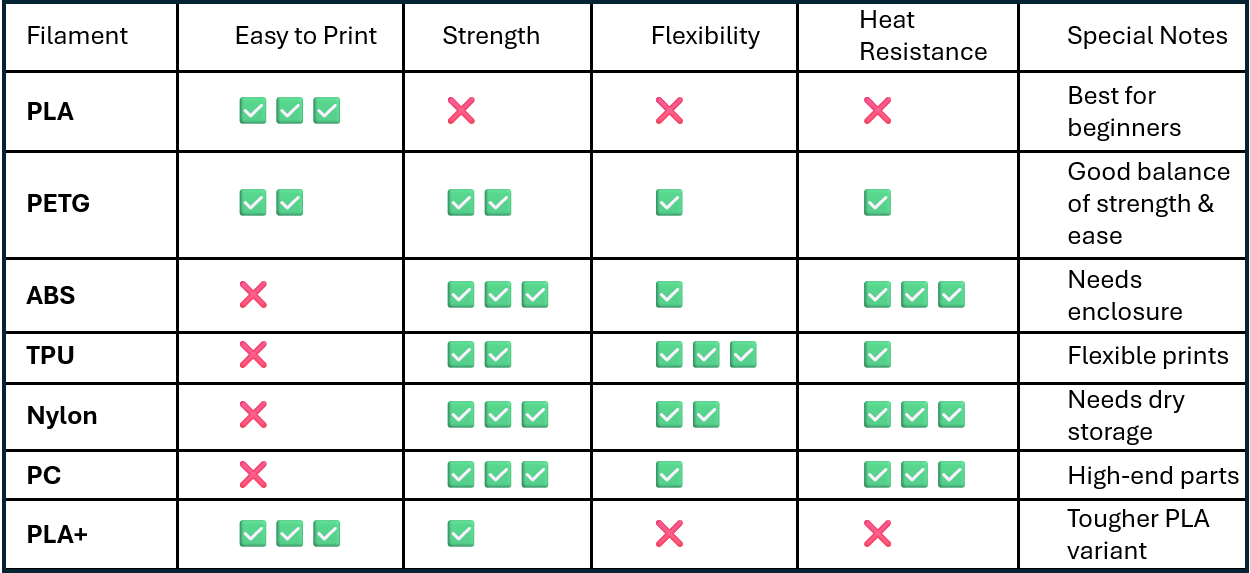 Understanding each material's strengths and limits saves you wasted time, filament, and frustration. Match the material to where the part will actually be used.
## The filaments
The easiest and most beginner-friendly filament, made from plant starch and biodegradable.
* **Pros:** Easy to print, low warping, excellent surface finish, no heated bed strictly required, biodegradable
* **Cons:** Brittle, poor heat resistance (softens near 60 C), not for mechanical parts
* **Best for:** Prototypes, toys, decorative items, low-stress parts, classroom use
* **Nozzle:** 190 - 220 C (start at 200 C)
* **Bed:** 50 - 65 C (start at 60 C)
* **Cooling:** Strong part cooling
This is what you print with all week.
A tough, water-resistant middle ground between PLA and ABS.
* **Pros:** Strong, slightly flexible, good layer adhesion, water resistant, better heat resistance than PLA
* **Cons:** Prone to stringing, harder to dial in, absorbs moisture
* **Best for:** Mechanical parts, food-safe containers, brackets, outdoor items
* **Nozzle:** 220 - 250 C (start at 235 C)
* **Bed:** 70 - 90 C (start at 80 C)
* **Cooling:** Low or none (30 - 50% fan max)
Sticks aggressively to PEI - use a glue-stick barrier so it does not damage the plate.
Strong and heat-resistant, but demanding to print.
* **Pros:** Strong, durable, heat resistant, can be smoothed with acetone
* **Cons:** Warps easily, emits fumes, needs a heated bed and an enclosure
* **Best for:** Functional parts, enclosures, automotive components, snap-fit assemblies
* **Nozzle:** 230 - 250 C (start at 240 C)
* **Bed:** 90 - 110 C (start at 100 C)
* **Cooling:** Minimal
Print in a well-ventilated space and avoid drafts, which cause cracking.
A flexible, rubber-like filament.
* **Pros:** Flexible, impact and abrasion resistant, good layer adhesion
* **Cons:** Slow and tricky to print, works best with a direct-drive extruder
* **Best for:** Phone cases, gaskets, seals, wearables, vibration dampers
* **Nozzle:** 210 - 230 C (start at 220 C)
* **Bed:** 40 - 60 C (start at 50 C)
* **Cooling:** Low to moderate
Print slowly so the flexible filament does not jam or compress in the extruder.
Extremely strong and durable, but very sensitive to moisture.
* **Pros:** Very strong, high impact and abrasion resistance, flexible yet structural, high heat resistance
* **Cons:** Absorbs moisture very quickly, warps without a heated bed and enclosure, expensive
* **Best for:** Gears, hinges, bushings, functional mechanical parts
* **Nozzle:** 240 - 260 C (start at 250 C)
* **Bed:** 70 - 100 C (start at 90 C)
* **Cooling:** Minimal to none
Must be kept dry - dry it before every print.
One of the strongest and most heat-resistant common filaments.
* **Pros:** Extremely strong and heat resistant, excellent impact resistance, slight flex under stress
* **Cons:** Needs very high temperatures, warps easily, absorbs moisture, hard to dial in
* **Best for:** Engineering prototypes, high-temperature parts, load-bearing components
* **Nozzle:** 250 - 300 C (start at 270 C)
* **Bed:** 90 - 110 C (start at 100 C)
* **Cooling:** None
Requires a fully enclosed printer with a heated chamber.
An upgraded PLA that keeps the easy printing but adds toughness.
* **Pros:** Stronger and less brittle than standard PLA, easy to print, good surface quality
* **Cons:** Still poor heat resistance, slightly more expensive
* **Best for:** Stronger functional parts, upgraded decorative prints, entry-level mechanical parts
* **Nozzle:** 205 - 225 C (start at 210 C)
* **Bed:** 50 - 70 C (start at 60 C)
* **Cooling:** Benefits from cooling
Often used as a dissolvable support material for ABS.
* **Pros:** Dissolves in limonene, similar strength to ABS
* **Cons:** Rarely used on its own, needs a heated bed and enclosure
* **Best for:** Dissolvable supports in dual-extrusion ABS prints, lightweight structural parts
* **Nozzle:** 230 - 245 C (start at 235 C)
* **Bed:** 90 - 110 C (start at 100 C)
* **Cooling:** None or low
## Temperature quick reference
Understanding each material's strengths and limits saves you wasted time, filament, and frustration. Match the material to where the part will actually be used.
## The filaments
The easiest and most beginner-friendly filament, made from plant starch and biodegradable.
* **Pros:** Easy to print, low warping, excellent surface finish, no heated bed strictly required, biodegradable
* **Cons:** Brittle, poor heat resistance (softens near 60 C), not for mechanical parts
* **Best for:** Prototypes, toys, decorative items, low-stress parts, classroom use
* **Nozzle:** 190 - 220 C (start at 200 C)
* **Bed:** 50 - 65 C (start at 60 C)
* **Cooling:** Strong part cooling
This is what you print with all week.
A tough, water-resistant middle ground between PLA and ABS.
* **Pros:** Strong, slightly flexible, good layer adhesion, water resistant, better heat resistance than PLA
* **Cons:** Prone to stringing, harder to dial in, absorbs moisture
* **Best for:** Mechanical parts, food-safe containers, brackets, outdoor items
* **Nozzle:** 220 - 250 C (start at 235 C)
* **Bed:** 70 - 90 C (start at 80 C)
* **Cooling:** Low or none (30 - 50% fan max)
Sticks aggressively to PEI - use a glue-stick barrier so it does not damage the plate.
Strong and heat-resistant, but demanding to print.
* **Pros:** Strong, durable, heat resistant, can be smoothed with acetone
* **Cons:** Warps easily, emits fumes, needs a heated bed and an enclosure
* **Best for:** Functional parts, enclosures, automotive components, snap-fit assemblies
* **Nozzle:** 230 - 250 C (start at 240 C)
* **Bed:** 90 - 110 C (start at 100 C)
* **Cooling:** Minimal
Print in a well-ventilated space and avoid drafts, which cause cracking.
A flexible, rubber-like filament.
* **Pros:** Flexible, impact and abrasion resistant, good layer adhesion
* **Cons:** Slow and tricky to print, works best with a direct-drive extruder
* **Best for:** Phone cases, gaskets, seals, wearables, vibration dampers
* **Nozzle:** 210 - 230 C (start at 220 C)
* **Bed:** 40 - 60 C (start at 50 C)
* **Cooling:** Low to moderate
Print slowly so the flexible filament does not jam or compress in the extruder.
Extremely strong and durable, but very sensitive to moisture.
* **Pros:** Very strong, high impact and abrasion resistance, flexible yet structural, high heat resistance
* **Cons:** Absorbs moisture very quickly, warps without a heated bed and enclosure, expensive
* **Best for:** Gears, hinges, bushings, functional mechanical parts
* **Nozzle:** 240 - 260 C (start at 250 C)
* **Bed:** 70 - 100 C (start at 90 C)
* **Cooling:** Minimal to none
Must be kept dry - dry it before every print.
One of the strongest and most heat-resistant common filaments.
* **Pros:** Extremely strong and heat resistant, excellent impact resistance, slight flex under stress
* **Cons:** Needs very high temperatures, warps easily, absorbs moisture, hard to dial in
* **Best for:** Engineering prototypes, high-temperature parts, load-bearing components
* **Nozzle:** 250 - 300 C (start at 270 C)
* **Bed:** 90 - 110 C (start at 100 C)
* **Cooling:** None
Requires a fully enclosed printer with a heated chamber.
An upgraded PLA that keeps the easy printing but adds toughness.
* **Pros:** Stronger and less brittle than standard PLA, easy to print, good surface quality
* **Cons:** Still poor heat resistance, slightly more expensive
* **Best for:** Stronger functional parts, upgraded decorative prints, entry-level mechanical parts
* **Nozzle:** 205 - 225 C (start at 210 C)
* **Bed:** 50 - 70 C (start at 60 C)
* **Cooling:** Benefits from cooling
Often used as a dissolvable support material for ABS.
* **Pros:** Dissolves in limonene, similar strength to ABS
* **Cons:** Rarely used on its own, needs a heated bed and enclosure
* **Best for:** Dissolvable supports in dual-extrusion ABS prints, lightweight structural parts
* **Nozzle:** 230 - 245 C (start at 235 C)
* **Bed:** 90 - 110 C (start at 100 C)
* **Cooling:** None or low
## Temperature quick reference
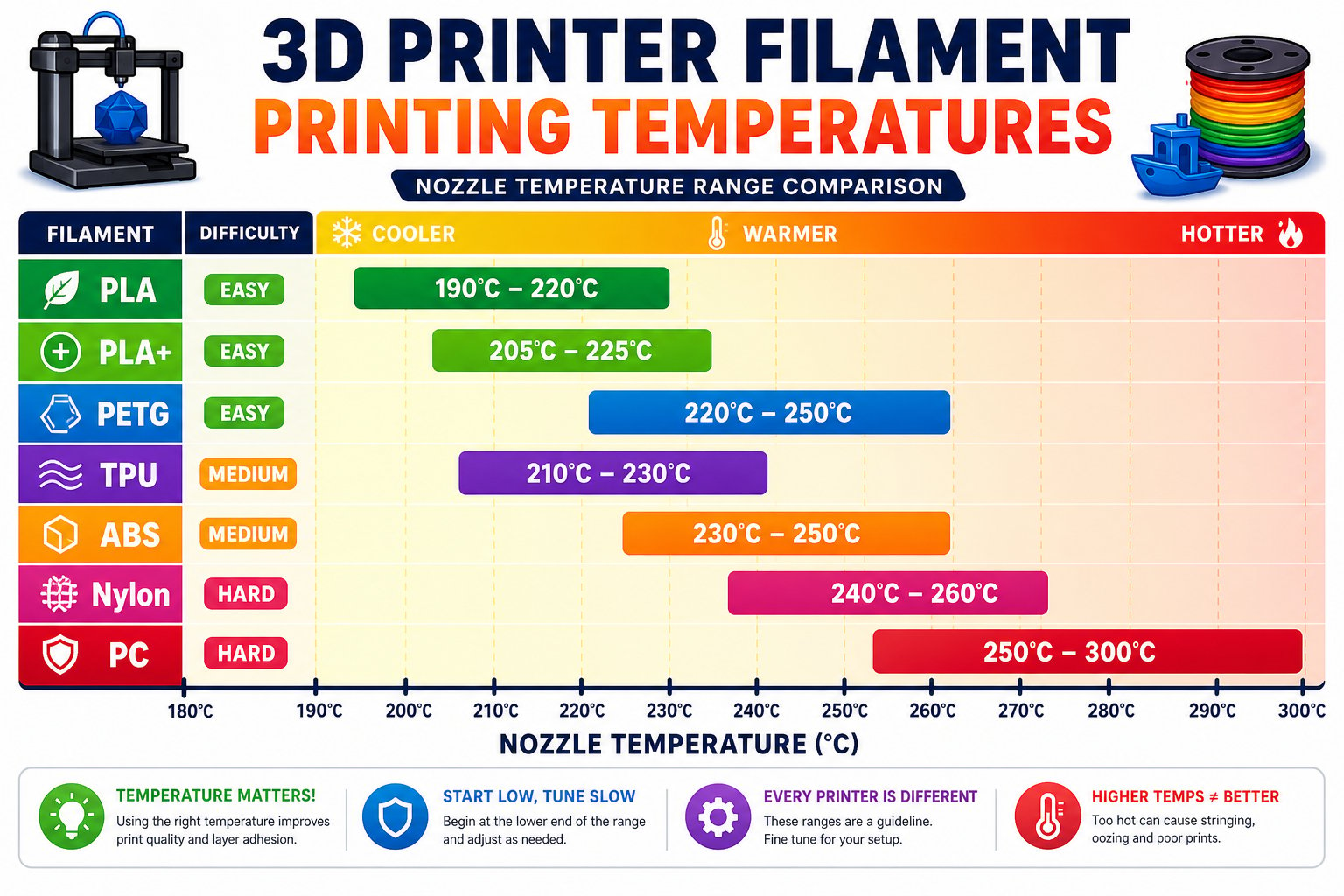 | Filament | Nozzle temp | Bed temp | Difficulty |
| -------- | ----------- | ---------- | ---------- |
| PLA | 190 - 220 C | 50 - 65 C | Easy |
| PLA+ | 205 - 225 C | 50 - 70 C | Easy |
| PETG | 220 - 250 C | 70 - 90 C | Medium |
| TPU | 210 - 230 C | 40 - 60 C | Medium |
| ABS | 230 - 250 C | 90 - 110 C | Hard |
| HIPS | 230 - 245 C | 90 - 110 C | Hard |
| Nylon | 240 - 260 C | 70 - 100 C | Hard |
| PC | 250 - 300 C | 90 - 110 C | Very hard |
The Adventurer 5M's maximum nozzle temperature is **280 C**, and it is an open-frame printer. It is ideal for PLA, PETG, and TPU. Materials like PC and Nylon that need an enclosure or higher temperatures are not recommended without upgrades.
## How to choose
Choose **PLA** or **PLA+**. Easy, forgiving, and great-looking.
Choose **PETG**. Strong, durable, and water resistant without an enclosure.
Choose **TPU**. Rubbery and impact resistant - print it slowly.
You can match a filament to a job and know its rough nozzle and bed temperatures. For this camp, PLA is your go-to material.
Next we cover why keeping filament **dry** matters so much - wet filament is one of the most common hidden causes of poor prints.
| Filament | Nozzle temp | Bed temp | Difficulty |
| -------- | ----------- | ---------- | ---------- |
| PLA | 190 - 220 C | 50 - 65 C | Easy |
| PLA+ | 205 - 225 C | 50 - 70 C | Easy |
| PETG | 220 - 250 C | 70 - 90 C | Medium |
| TPU | 210 - 230 C | 40 - 60 C | Medium |
| ABS | 230 - 250 C | 90 - 110 C | Hard |
| HIPS | 230 - 245 C | 90 - 110 C | Hard |
| Nylon | 240 - 260 C | 70 - 100 C | Hard |
| PC | 250 - 300 C | 90 - 110 C | Very hard |
The Adventurer 5M's maximum nozzle temperature is **280 C**, and it is an open-frame printer. It is ideal for PLA, PETG, and TPU. Materials like PC and Nylon that need an enclosure or higher temperatures are not recommended without upgrades.
## How to choose
Choose **PLA** or **PLA+**. Easy, forgiving, and great-looking.
Choose **PETG**. Strong, durable, and water resistant without an enclosure.
Choose **TPU**. Rubbery and impact resistant - print it slowly.
You can match a filament to a job and know its rough nozzle and bed temperatures. For this camp, PLA is your go-to material.
Next we cover why keeping filament **dry** matters so much - wet filament is one of the most common hidden causes of poor prints.